泡
Character Story & Explanation
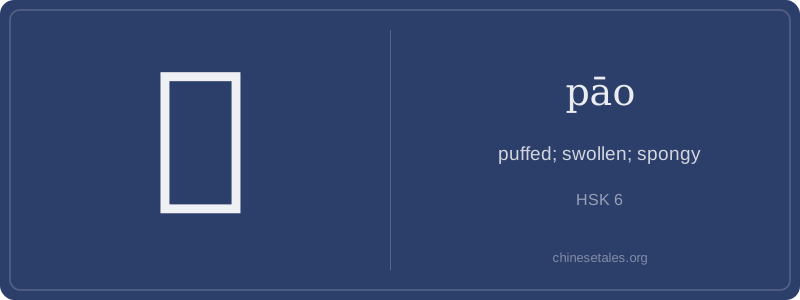
The earliest form of 泡 appears in seal script as 氵+包 — a deliberate fusion: the water radical (氵) on the left, and 包 (bāo, ‘to wrap, enclose’) on the right. But this wasn’t arbitrary. In oracle bone inscriptions, 包 itself depicted a fetus in the womb — a soft, fluid-filled sac swelling within a boundary. When paired with water, the image became visceral: *something enclosed by liquid, expanding from within*. Over centuries, the top stroke of 包 simplified, the middle ‘wrapping’ curve flattened, and the modern eight-stroke 泡 emerged — still holding that core idea of containment + expansion.
This visual logic anchored its meaning across dynasties. In the Tang dynasty, poets used 泡 to describe rain-swollen riverbanks (‘the bank swelled like a water-filled pouch’); by the Ming, medical texts applied it to edematous tissue. Even today, the character’s shape whispers its secret: three water dots (氵) dripping down the left side, while the right side — 包 — looks like a rounded, bulging bag. It doesn’t just mean ‘swollen’ — it *shows* swelling in motion, captured mid-puff.
At its heart, 泡 (pāo) evokes something soft, expanded, and slightly unstable — like bread dough rising, a waterlogged sponge, or skin that’s swollen after a bee sting. It’s not just ‘big’; it’s *distended* by internal pressure or absorbed moisture, often with a hint of fragility or impermanence. This tactile, almost physical quality is central: Chinese speakers instinctively feel the ‘give’ in 泡 — think of foam collapsing or a blister about to burst.
Grammatically, 泡 (pāo) appears mainly as an adjective or stative verb in formal or literary contexts — never as a standalone action verb (that’s pào!). You’ll hear it in compound adjectives like 泡肿 (pāo zhǒng, ‘puffed up’) or describing textures: 这块木头泡得发软了 (zhè kuài mù tou pāo de fā ruǎn le, ‘This wood has soaked and turned spongy’). Crucially, it’s rarely used alone — learners often overgeneralize it like English ‘puffed’, but native speakers pair it tightly with verbs or nouns that specify *how* or *why* something swells.
Culturally, 泡 (pāo) carries subtle connotations of unnatural or unhealthy expansion — e.g., 泡水 (pāo shuǐ, ‘waterlogged’) implies damage, not hydration. A classic mistake? Confusing it with the far more common pào pronunciation (as in 喝茶, hē chá — ‘to steep tea’), leading to unintentionally medical-sounding sentences! Remember: pāo is *static condition*; pào is *active process*. The tone shift isn’t just phonetic — it’s semantic gravity.