汹
Character Story & Explanation
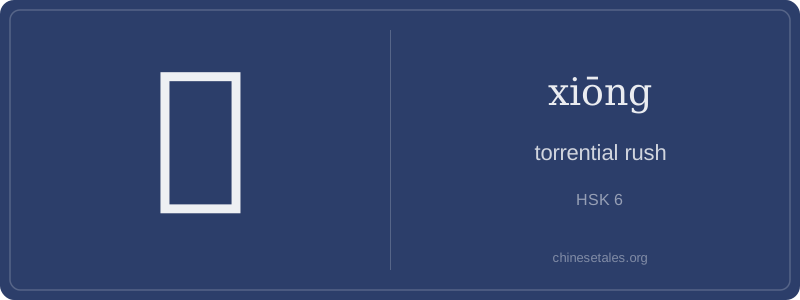
The earliest form of 汹 appears in bronze inscriptions as a flowing water radical (氵) beside a phonetic component that evolved into 凶 — but crucially, this ‘凶’ wasn’t the standalone character for ‘ferocious’; it was a simplified depiction of a *roaring mouth* or *gaping void*, suggesting sound and emptiness. Over time, the water radical stabilized as three dots (氵), and the right side hardened into 凶 (xiōng), preserving both the aquatic meaning and the vocal, explosive quality — a visual pun: water that *roars*. By the seal script era, the seven-stroke structure was fixed: three water dots + four strokes forming 凶.
This dual origin explains why 汹 feels so sonically charged — it’s not just movement, but *acoustic turbulence*. In the Classic of Poetry (Shījīng), early variants describe rivers ‘roaring as if shouting’ (湷湷, a variant pronunciation), linking sound and force. Later, in Tang dynasty poetry and Ming-Qing vernacular fiction, 汹 became the go-to character for depicting overwhelming, almost sentient natural power — like Du Fu’s description of Yangtze floods ‘roaring with heaven-shaking force’. Its shape still whispers: water + a gaping mouth = nature screaming.
At its core, 汹 (xiōng) doesn’t just mean ‘torrential rush’ — it’s the sound and fury of water in violent, uncontrolled motion: churning waves, surging floodwaters, or even metaphorical upheavals like a roiling crowd or an outburst of emotion. Think less ‘flow’ and more ‘frenzy’ — it’s visceral, onomatopoeic, and almost always paired with other words to amplify intensity, never used alone as a verb or standalone noun.
Grammatically, 汹 is nearly always found in reduplicated forms (汹汹) or compounds like 汹涌 (xiōngyǒng) — never as a bare verb (*他汹了 is impossible). It functions adjectivally or adverbially: 汹涌的人潮 (a surging crowd), 气势汹汹 (menacingly aggressive, literally ‘with imposing, roaring momentum’). Learners often mistakenly treat it like a transitive verb or try to use it without its standard collocates — but 汹 has no independent action; it only *describes* the character of motion or energy.
Culturally, 汹 carries a subtle moral weight: in classical texts, 气势汹汹 implies dangerous arrogance, while 汹涌 is neutral or even positive when describing natural forces or revolutionary energy (e.g., 历史的汹涌潮流 — ‘the surging tide of history’). A common pitfall? Confusing it with 形 (xíng) or 凶 (xiōng) — same pinyin, wildly different meanings and shapes. Remember: 汹 is all about *water’s roar*, not form or ferocity in the abstract.