涕
Character Story & Explanation
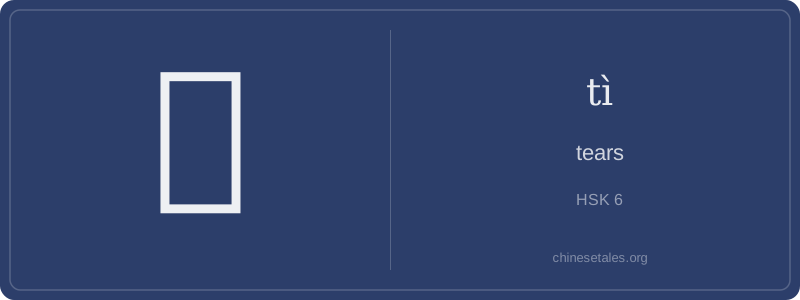
The earliest form of 涕 appears in bronze inscriptions around 1000 BCE — not as a pictograph of tears, but as a compound: the left side was 水 (shuǐ, water), simplified over time to 氵, and the right was 弟 (dì, younger brother), serving phonetically. But here’s the twist: 弟 wasn’t chosen randomly — its ancient pronunciation closely matched tì, and its shape (a person kneeling beside a 'ground' line) subtly echoed the posture of mourning. As seal script evolved, the water radical stabilized on the left, while 弟 lost its top stroke and gained a dot, becoming today’s 涕 — ten strokes total, with the three dots of 氵 flowing like falling drops.
This character didn’t mean 'tears' at first — early uses referred to nasal discharge, reflecting ancient Chinese medicine’s view that tears and mucus shared the same yin-fluid origin. By the Warring States period, however, 涕 had shifted to emphasize emotional tears, especially in contexts of filial grief. The Book of Rites notes: 'When one mourns sincerely, 涕 and 泗 flow together' — cementing its role as the linguistic signature of authentic sorrow. Its visual logic remains elegant: water + phonetic = a character whose very shape whispers 'liquid emotion'.
At first glance, 涕 (tì) feels like a quiet, classical word — it means 'tears', yes, but not the everyday kind you wipe with a tissue. Think of it as the tears that fall in profound grief, solemn gratitude, or overwhelming emotion: the kind that appear in poetry, historical texts, and formal speeches. It’s rarely used alone; you’ll almost always see it paired — like 涕泗 (tì sì), where 泗 means 'nasal mucus', evoking the full, uncontrolled physicality of weeping. Unlike 眼泪 (yǎnlèi), which is neutral and conversational, 涕 carries gravity and literary weight.
Grammatically, 涕 is a noun, but it behaves differently from English 'tears'. It doesn’t pluralize (no 's'), and it rarely takes measure words like 一滴 (yī dī) — instead, it appears in fixed compounds or as part of verb-object phrases like 涕下 (tì xià, 'tears fall') or 涕零 (tì líng, 'tears drip down'). Learners often mistakenly use it in casual speech ('I cried' → *我涕了), but no — that’s unnatural. Say 我哭了 or 我流眼泪了 instead. 涕 only belongs where language bows its head: in elegies, memorial inscriptions, or when describing someone’s reaction to a national tragedy.
Culturally, 涕 is deeply tied to Confucian ideals of sincere, restrained yet visceral emotion — tears not of weakness, but of moral resonance. In the Classic of Filial Piety, tears are described as ‘the voice of the heart’ (心之聲), and 涕 is the character that carries that solemnity. A common mistake? Confusing it with 悌 (tì, 'respect for elders') — same sound, wildly different meaning and radical. Remember: water (氵) = body fluid; heart (忄) = social virtue.