涮
Character Story & Explanation
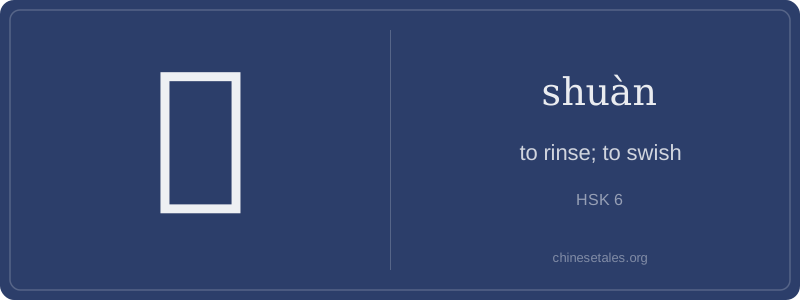
The character 涮 first appeared in seal script during the Warring States period, evolving from a combination of 氵 (water radical) and 刷 (shuā, ‘to brush’), which itself derived from an ancient pictograph of a hand holding a bristle tool. In early forms, the right side resembled a simplified ‘brush’ glyph — not a sword or knife — emphasizing the *motion* of back-and-forth contact. By the Han dynasty, the structure stabilized: three dots of water on the left (氵), and the phonetic-semantic component 刷 on the right — now standardized to its modern 11-stroke form, where the final ‘dot’ stroke (丶) subtly echoes the tip of a brush dipped and lifted.
This visual logic — water + brushing motion — directly shaped its meaning: not passive soaking, but active, repeated contact between liquid and surface. Classical usage is rare, but by the Ming-Qing era, 涮 appears in vernacular texts describing tea ceremony rituals (‘swishing leaves to release fragrance’) and later, in Beijing opera scripts, referencing the rapid, stylized hand gestures of performers — ‘swishing’ through motions like water. Its modern hotpot association solidified in 20th-century northern China, where 涮羊肉 (shuàn yángròu) became iconic — a perfect semantic marriage of motion, medium, and culture.
At its core, 涮 (shuàn) isn’t just ‘to rinse’ — it’s the sound and motion of water in quick, rhythmic contact: swish-swish-swish. Think of dipping fresh lamb into boiling broth for seconds in hotpot, or swirling tea leaves in a cup to wake their aroma. It implies lightness, speed, and repetition — not thorough cleaning like 洗 (xǐ), but a deliberate, almost performative cleansing or preparation. That tactile, kinetic feel is deeply embedded in Chinese culinary and daily aesthetics: efficiency with elegance, function with flair.
Grammatically, 涮 is usually transitive and often appears in serial verb constructions or as a verb-object compound. You don’t just ‘shuàn’ — you ‘shuàn ròu’ (rinse meat), ‘shuàn chá’ (swish tea), or ‘shuàn yīfu’ (rinse clothes lightly). It rarely stands alone; context defines whether it’s culinary, hygienic, or even figurative (e.g., 涮人 — slang for ‘to prank someone’, evoking the swift, playful ‘swish’ of teasing). Learners often overuse it where 洗 fits better — using 涮 for laundry or dishes implies ‘just a quick dip’, not real washing!
Culturally, 涮 reveals how Chinese language encodes intentionality in action verbs. The same physical motion — water + object — gets distinct characters based on *how* and *why*: 洗 (thorough scrub), 冲 (forceful rinse), 淋 (pour over), and 涮 (light, repeated swishing). This precision mirrors values of appropriateness and contextual awareness. Also, be warned: in Beijing dialect, 涮 can mean ‘to tease’ — a playful extension from the idea of ‘swishing words around’ — so tone and register matter more than you’d think!