渡
Character Story & Explanation
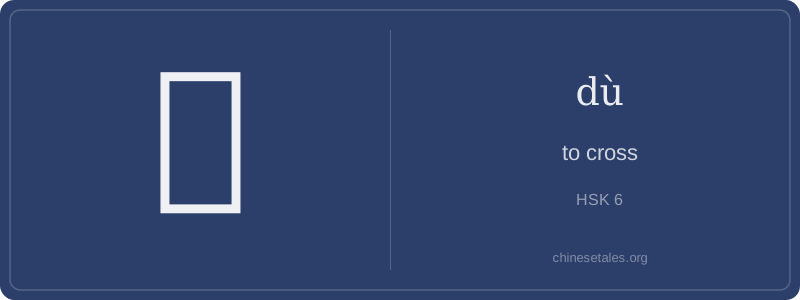
The earliest form of 渡 appears in seal script as a combination of 水 (water, later simplified to 氵) and 度 — which itself evolved from a pictograph of a measuring rod (庶) plus ‘foot’ (止), signifying ‘measured walking’. In bronze inscriptions, it depicted a person standing beside water, holding a staff to test depth before wading — a literal act of *measuring the crossing*. Over centuries, the water radical condensed into three dots, the measuring component hardened into 度’s modern shape, and the whole character stabilized by the Han dynasty with its current 12-stroke structure: 氵 + 度 (each stroke carefully placed — notice the dot-dot-dot, then the horizontal stroke of 度’s 广, followed by the precise diagonal and hook).
This visual logic shaped its meaning: crossing wasn’t random — it was deliberate, assessed, and often sacred. In the Classic of Poetry, 渡 described feudal lords crossing rivers to pay homage — a ritualized transition between domains. By the Tang dynasty, poets like Li Bai used 渡 metaphorically: ‘渡远荆门外’ (crossing beyond the Jingmen Gate) fused geography with existential departure. Even today, the character’s form whispers its origin: three drops of water demand attention, and 度 insists — you don’t rush this crossing; you *measure* it.
At its heart, 渡 (dù) is all about *crossing a body of water* — not just physically, but metaphorically: crossing thresholds, eras, crises, or even life itself. Unlike generic 'to go' verbs, 渡 carries weight, intention, and often peril. Its radical 氵 (three dots of water) screams aquatic context, while the right side 度 (dù, 'to measure' or 'degree') hints at *calculated passage* — you don’t just splash across; you gauge the current, time the tide, and navigate deliberately.
Grammatically, 渡 is almost always transitive and formal. You 渡河 (cross a river), 渡海 (cross the sea), or 渡过难关 (cross over a difficult period). Crucially, it’s rarely used for land crossings (use 过 or 穿越 instead) or casual movement (use 走 or 经过). Learners often mistakenly say 我渡了桥 ('I crossed the bridge') — wrong! Bridges are structures you *walk across*, not watery barriers you *navigate*. Also, note that 渡 is almost never used in the simple past without aspect markers like 了 or 过 — 'I crossed the Yangtze' must be 我渡过了长江, not *我渡长江.
Culturally, 渡 evokes heroic or historic crossings: Mao’s Long March included crossing rivers under fire; Buddhist texts speak of 渡众生 (‘crossing sentient beings’ — i.e., helping others reach enlightenment). Misusing it flattens nuance — saying 渡时间 sounds bizarre (use 度过), because time isn’t a river to be forded, but an experience to be *lived through*. This character doesn’t just move you from A to B — it demands respect for the medium, the method, and the meaning of the crossing.