渺
Character Story & Explanation
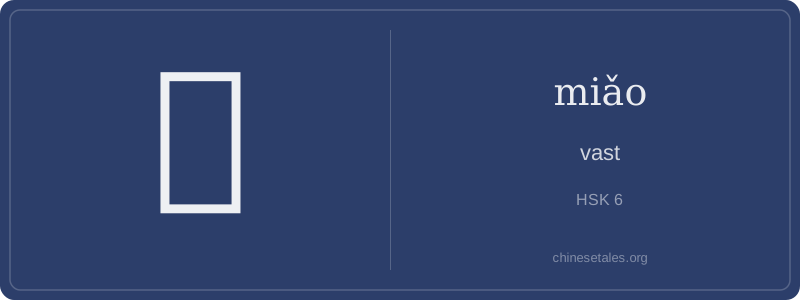
The earliest form of 渺 appears in seal script, where the left side was clearly the ‘water’ radical (氵), and the right side was 眇 — itself composed of ‘eye’ (目) atop ‘small’ (少), picturing an eye straining to see something faintly visible in the distance. Over centuries, the ‘eye’ component simplified and merged with ‘small’, evolving into the modern 眇 shape you see today — three dots (representing water’s flow), then the curved stroke of ‘eye’ bending downward, followed by the compact ‘small’ structure. Every stroke echoes movement: water receding, vision narrowing, horizon dissolving.
This visual logic directly shaped its meaning. In the *Chu Ci* (Songs of Chu), 渺 was used to describe rivers vanishing into misty mountains — not just ‘long’, but ‘so long it fades from sight’. By Tang dynasty poetry, it had crystallized into a metaphysical descriptor: Li Bai wrote of ‘渺然’ (miǎo rán) — a state of being so absorbed in nature that self dissolves into boundless space. The character doesn’t just name size; it names the *sensory limit* where the eye fails and imagination begins — a uniquely Chinese fusion of landscape, perception, and existential scale.
At its heart, 渺 isn’t just ‘vast’ — it’s the quiet awe of standing on a shore and watching the sea dissolve into mist on the horizon: vast *and* indistinct, immense *and* distant. The water radical (氵) anchors it in fluidity and boundlessness, while the right side, 眇 (miǎo), originally meant ‘to squint’ or ‘to peer with difficulty’ — hinting at how something so enormous blurs at the edges, defying clear perception. This duality — scale + elusiveness — is essential: 渺 rarely describes measurable size (like 巨大), but rather subjective, almost poetic immensity: time, space, hope, or silence that feels too large to grasp.
Grammatically, 渺 is almost always an adjective, but it’s highly literary and rarely stands alone. You’ll find it in fixed compounds (渺小, 渺茫) or as a descriptive modifier before nouns — often paired with words evoking distance or abstraction: 渺远的山影 (distant mountain silhouettes), 渺不可测的宇宙 (an unfathomably vast universe). Learners mistakenly use it like ‘big’ or ‘large’ — but saying *这个房间很渺* is jarring; it’s not colloquial for physical objects. It thrives in written narrative, poetry, and philosophical reflection — never in a shopping list.
Culturally, 渺 carries a subtle Daoist-Buddhist resonance: its vastness implies impermanence and humility. In classical texts like the *Zhuangzi*, 渺茫 evokes the hazy boundary between dream and waking reality. A common error is over-translating it as ‘tiny’ (confusing it with its antonym contextually); remember: 渺 itself means *vast*, but when paired with 小 (as in 渺小), it intensifies the contrast — ‘infinitesimally small *against* an overwhelming vastness’. That relational tension is everything.