涩
Character Story & Explanation
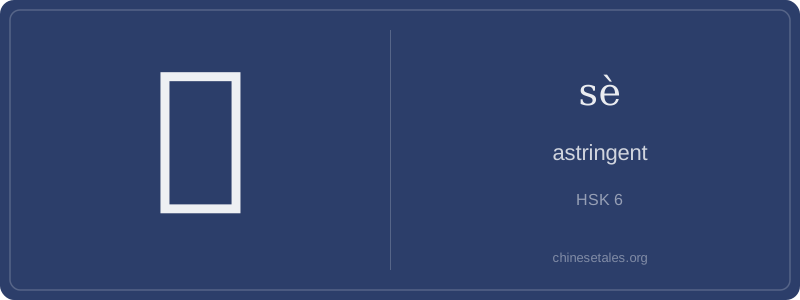
The earliest form of 涩 appears in Han dynasty clerical script, evolving from a character combining 氵 (water) and 刀 (knife) — not literally a knife in water, but a stylized representation of 'cutting resistance': imagine dragging a blade through thick, sticky sap or dried mud. The modern 10-stroke form crystallized by the Tang dynasty: three dots (氵) on the left for liquid or fluidity, and 又 (yòu, 'again') + 刂 (dāo, knife radical) on the right — suggesting repeated friction, a surface that resists smooth passage. Notice how the 又 component looks like a grasping hand — reinforcing the tactile, gripping quality of astringency.
This tactile origin grounded its semantic expansion: by the Song dynasty, medical texts like 《太平惠民和剂局方》 used 涩 to describe herbs that 'bind and constrict' — stopping leakage of fluids (e.g., diarrhea or night sweats). In poetry, Li Qingzhao lamented '词意涩滞' (her lines felt rough and stalled), linking physical texture to linguistic flow. The character never lost its visceral core: whether describing a tongue-coating persimmon, a stiff tendon, or an emotionally 'blocked' conversation, 涩 always implies resistance to easy movement — a beautiful, stubborn friction at the heart of Chinese perception.
Think of 涩 (sè) as Chinese tea’s version of a dry red wine’s 'tannic bite' — that puckering, mouth-drying sensation you get from unripe persimmons or over-steeped green tea. It’s not just taste: in Chinese, 涩 evokes physical tightness (a stiff joint), emotional restraint (a hesitant speech), or even aesthetic roughness (a matte, grainy painting). Unlike English 'astringent', which sounds like a lab report, 涩 is deeply sensory and poetic — it’s the word used when a poet describes a voice ‘sè sè’ (涩涩), meaning strained and lacking fluency.
Grammatically, 涩 is almost always an adjective, but it rarely stands alone. You’ll see it doubled (涩涩) for softness or intensity, or in compounds like 苦涩 (bitter-astringent, i.e., painfully bittersweet) or 涩滞 (sè zhì, 'stuck-and-rough', describing sluggish qi flow in TCM or a stuttering computer interface). Learners often mistakenly use it like 'bitter' (苦) — but while 苦 is sharp and clear, 涩 is dull, clinging, and textural: coffee can be 苦, but under-extracted espresso tastes 涩.
Culturally, 涩 carries quiet moral weight: in classical criticism, a 'sè' poem is one whose language feels forced or immature — like a young scholar still mastering rhythm. Modern slang even uses 涩 to describe awkward, socially stilted behavior ('他说话好涩啊!' — 'His speech is so awkward!'). A common error? Confusing it with 色 (sè, 'color') — homophone, totally unrelated. Remember: 涩 has water (氵), not flesh (⺼); it’s about *sensation*, not sight.