澄
Character Story & Explanation
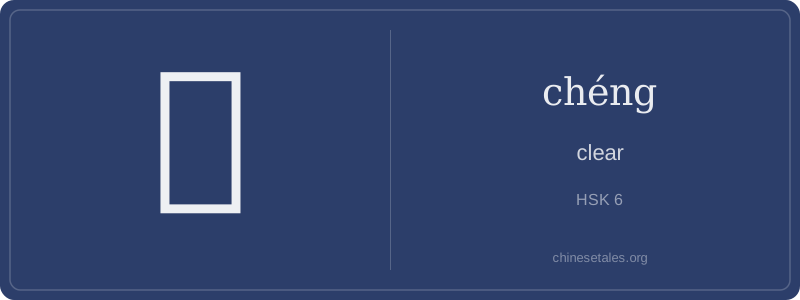
The earliest form of 澄 appears in seal script as a combination of 氵 (water radical) and 登 (dēng, ‘to ascend’), which itself evolved from a pictograph of feet climbing a ladder or steps. The original bronze inscriptions show three drops of water beside a stylized figure stepping upward—suggesting water rising, or more poetically, water *ascending into clarity*: impurities sinking, pure essence rising. Over centuries, 登 simplified into its modern form (a horizontal stroke, then 疋 + 豆), while the water radical solidified as three dots—always on the left, anchoring the character’s aquatic essence.
This visual logic shaped its semantic journey: from literal ‘water becoming clear through settling’ (Zuo Zhuan, 5th c. BCE) to metaphorical ‘clarifying thought’ (Zhuangzi) and ‘purifying intent’ (Neo-Confucian texts). By the Tang dynasty, poets used 澄 to describe both moonlight on placid lakes and the enlightened mind—linking outer stillness with inner lucidity. Its structure is a perfect visual metaphor: water (氵) + ascent (登) = clarity achieved not by force, but by patient, natural rising and settling.
Imagine standing on a quiet lakeshore at dawn—the water so still and transparent you can see pebbles, reeds, even the slow drift of minnows ten feet down. That’s 澄 (chéng): not just ‘clear’ as in ‘transparent glass’, but clear *in depth*, *in stillness*, *in moral purity*. It’s the clarity that comes after turbulence settles—not instant transparency, but the profound calm of sediment sinking and light penetrating all the way to the bottom.
Grammatically, 澄 is almost always used in compound words (like 澄清 or 澄澈) or as a verb meaning ‘to clarify’—especially abstract things: ideas, intentions, misunderstandings. You’d never say *‘the sky is chéng’*; instead, you’d say *‘tā bǎ wèntí chéngqīng le’* (他把问题澄清了)—‘He clarified the issue’. Note: it’s rarely standalone in speech, and never an adjective before nouns like ‘clear water’ (that’s 清水, qīng shuǐ). Learners often overuse it adjectivally or confuse it with simpler synonyms like 清.
Culturally, 澄 carries Daoist and Chan Buddhist resonance—it evokes the mind ‘clarified’ through meditation, like muddy water left undisturbed until it becomes lucid. In classical poetry, 澄 appears in lines describing both physical lakes and inner stillness (e.g., Wang Wei’s ‘澄江静如练’—‘The limpid river lies still as white silk’). Pronounced dèng only in rare surnames or archaic place names—ignore dèng unless your teacher calls roll in a Ming-dynasty village.