告
Character Story & Explanation
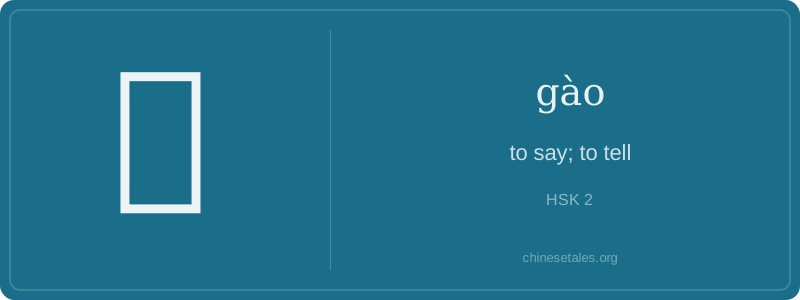
The earliest form of 告, found on Shang dynasty oracle bones, looked strikingly like a cow’s head (牛) placed atop a raised earthen platform (土) — not literally a cow, but a stylized representation of a sacrificial altar where prayers and declarations were made aloud to ancestors or gods. Over centuries, the cow-head simplified into the top component we see today (a bent line over two short strokes), while the platform became the lower 口 (mouth), emphasizing that this was *spoken* ritual. By the Qin seal script, the shape had stabilized into something close to modern 告: a compact 7-stroke character with clear upper ‘altar’ and lower ‘mouth’.
This visual logic directly shaped its meaning: speech delivered at the altar wasn’t casual chatter — it was testimony, petition, confession, or proclamation. In the *Analects*, Confucius uses 告 in phrases like ‘子告之曰’ (‘The Master told him thus’), underscoring authoritative, purposeful speech. Even today, the character’s architecture whispers that every act of 告 carries implicit responsibility — you’re not just saying words; you’re placing them on the altar of shared understanding.
At its heart, 告 (gào) is about *intentional communication* — not just any utterance, but a deliberate, often formal or consequential act of telling: reporting to authorities, announcing news, confessing, or even filing a lawsuit. Its radical 口 (mouth) anchors it in speech, but the top part isn’t decorative — it’s the ancient symbol for an altar or ritual platform (a simplified form of 牛 + 土 in oracle bones), suggesting speech offered with gravity, like a solemn declaration before elders or heaven. That’s why 告 feels weightier than 说 (shuō, ‘to speak’) or 讲 (jiǎng, ‘to explain’): you 告 someone *something important*, often with stakes.
Grammatically, it’s versatile but precise: it takes a direct object (what is told) and an indirect object (to whom), usually in the structure 告诉 (gàosu) — the most common modern usage — where 告 is the root and 诉 adds the nuance of ‘relaying’. Learners often mistakenly use 告 alone as a verb like ‘I tell him’, but standalone 告 is rare in speech; it appears mostly in compounds (e.g., 告别, 告状) or formal/written contexts (e.g., 法院告他 — ‘the court sues him’). Also, 告 never means ‘to say hello’ — that’s 问好 (wènhǎo).
Culturally, 告 carries echoes of ancient accountability: in classical texts like the *Book of Documents*, 告 was used for ministers reporting to the king or announcing divine mandates. Today, that solemnity lingers — 告密 (gàomì, ‘to inform on someone’) still implies moral risk, and 告别 (gàobié, ‘to take leave’) frames parting as a ritual act. A classic mistake? Using 告 instead of 告诉 when speaking casually — it sounds stiff or bureaucratic, like addressing a tribunal instead of your roommate.