咖
Character Story & Explanation
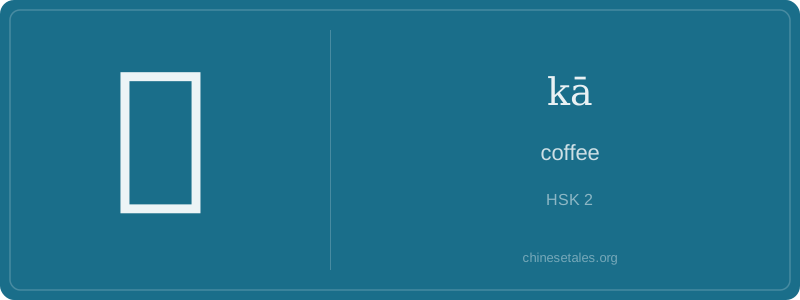
There is no ancient oracle bone or bronze script for 咖 — it didn’t exist before the 1800s. This character is a linguistic newborn, invented during the Qing dynasty to transcribe foreign words. Its structure is brilliantly pragmatic: take the existing character 加 (jiā, 'to add'), which already had the right 'jia' sound, then swap its left-side 'force' radical 力 for 口 ('mouth'), signaling that this is a spoken loanword — not a native concept. The stroke count stayed at 8, preserving familiarity while repurposing the shape: 口 (3 strokes) + 加 without 力 (5 strokes: + 口 + 口 → simplified to the modern 加 shape minus 力, yielding 口 + 加's remaining components).
The meaning emerged entirely from sound-matching: early Western traders and missionaries in Guangzhou and Shanghai needed a way to write 'coffee', and local printers chose 加 because 'jia' was the closest Mandarin approximation to the English 'cof-'. Over time, tone shifted from jiā to kā under influence of southern dialects and Japanese katakana カ (ka), cementing the modern pronunciation. By the 1920s, 咖 was standardized in dictionaries — not as a philosophical term, but as a humble sip of linguistic adaptation.
Think of 咖 (kā) not as a 'word' but as a phonetic guest in Chinese — it’s a transliteration character, born purely to mimic the foreign sound 'ca' (as in 'coffee'). Its radical 口 (kǒu, 'mouth') tells you instantly: this is about speech, sound, or something ingested — perfect for a beverage that’s sipped and named aloud. Unlike native Chinese characters with deep semantic roots, 咖 carries zero meaning on its own; it only works when paired — always in compounds like 咖啡 (kāfēi). You’ll never say *just* '咖' to mean coffee — that’s like saying 'ca' in English and expecting someone to hand you a latte.
Grammatically, 咖 appears exclusively in fixed loanword compounds. It never stands alone, never takes aspect particles (了, 过), and never functions as a verb or adjective — a key reason HSK 2 learners sometimes overextend it. For example, you can’t say '我咖了' (I coffee-ed!) — that’s ungrammatical nonsense. Instead, you say '我喝了咖啡' (I drank coffee). Also, note: 咖 is always the first syllable in kāfēi; reversing it to *啡咖* is as wrong as saying 'fee-ka' instead of 'ka-fee'.
Culturally, 咖 is a quiet ambassador of globalization — it entered Chinese in the late 19th century via Shanghai’s treaty-port cafes, adapted from English 'coffee' (via Shanghainese pronunciation and Japanese katakana カフェ). Learners often misread it as 'gā' (like 加) or confuse it with 嘉 or 家 — but remember: 口 + 加 = kā, not 'addition' or 'home'. And no, it has nothing to do with 'karaoke' — that’s 卡拉OK (kǎlā OK), a completely different transliteration path!