滤
Character Story & Explanation
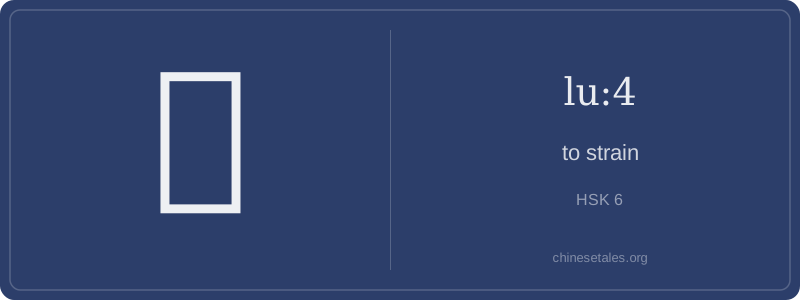
The earliest trace of 滤 appears not in oracle bones but in Han dynasty seal script, where it combined 氵 (water radical) on the left with 虑 (lǜ, 'to consider, worry') on the right — no pictograph of sieves or cloth. But here’s the twist: 虑 itself evolved from a bronze inscription showing a heart (心) beneath a roof (虍), symbolizing deep, sheltered thought. So 滤 began life as 'water + thoughtful containment' — not mechanical straining, but *deliberate, mindful separation*, as if water needed conscious judgment to decide what to keep and discard.
This philosophical nuance lingered: in Tang dynasty medical texts, 滤 described purifying herbal decoctions by letting sediment settle *and then carefully decanting* — a process requiring patience, observation, and restraint. By the Song, with advances in papermaking and ink production, 滤 gained its modern mechanical sense, yet the root idea remained: filtration isn’t just physics — it’s an act of discernment. The 13 strokes even echo this duality: 3 for water (氵), 10 for 虑 — a majority devoted to 'consideration', reminding us that true filtering begins in the mind before the mesh.
Think of 滤 (lǜ) as the Chinese cousin of a French press coffee maker — not just 'filtering' in the abstract, but a deliberate, physical act of separation: forcing liquid through a barrier to extract purity or remove impurities. Unlike English 'filter', which can be passive ('the air is filtered'), 滤 is almost always an active, intentional verb — someone *does* the filtering. You’ll rarely see it as a noun alone; instead, it appears in compounds like 过滤器 (guòlǜqì, 'filter device') or as a verb with clear agency: '她用纱布滤掉了汤里的渣滓' (She strained the broth’s residue through gauze).
Grammatically, 滤 is transitive and often paired with objects indicating what’s being removed (杂质, 渣滓, 气泡) or what’s doing the straining (纱布, 滤纸, 砂层). It’s rarely used without specifying *how* or *what’s left behind*. A common learner mistake? Using it like English ‘filter’ in metaphorical contexts — e.g., ‘filter information’ — where Chinese prefers 筛选 (shāixuǎn, 'sift/select') or 过滤 (guòlǜ, the more common compound form). Note: 滤 alone is literary and formal; in speech, you’ll almost always hear 过滤.
Culturally, 滤 carries quiet precision — it’s the character of labs, water treatment plants, and traditional apothecaries. Its tone (4th) feels decisive, like a tap shutting off impurity. Learners often mispronounce it as lú (2nd tone), confusing it with 路, but the sharp fall mirrors the action: a firm downward motion of pressing liquid through mesh.