泻
Character Story & Explanation
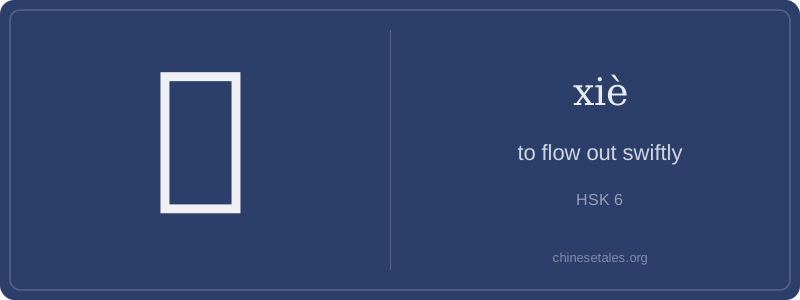
The earliest form of 泻 appears in seal script (c. 3rd century BCE), built from three clear components: the water radical 氵 on the left (three flowing dots), the phonetic component 写 (xiě, ‘to write’) on the right — but crucially, 写 itself evolved from an ancient pictograph of a hand holding a brush *dripping ink*. So visually, 泻 was literally ‘water + dripping-ink-hand’: a vivid image of liquid issuing rapidly downward, stroke by stroke mimicking the motion of ink splattering or water gushing from a crack.
This visual logic anchored its meaning across millennia. In the Shuōwén Jiězì (121 CE), Xu Shen defined it as ‘the swift descent of water’, citing river floods and medicinal purging. By the Tang dynasty, poets like Du Fu used 泻 metaphorically — ‘月光泻入窗’ (moonlight gushes into the window) — expanding it beyond physiology into sensory and emotional overflow. Even today, its shape whispers motion: those three water dots seem to tumble downward, and the right side 写, though now read xiè, still echoes the idea of something being *released* — not written, but *expelled* with urgency.
Imagine standing at the edge of a mountain gorge after a violent thunderstorm: suddenly, a roaring torrent bursts from a fissure in the cliffside — not a gentle stream, but a furious, unstoppable cascade tearing through rocks and mud. That’s 泻 (xiè): it doesn’t just ‘flow’ — it *spills*, *gushes*, *pours out with force and urgency*. In Chinese, this character carries visceral kinetic energy — always implying rapid, often uncontrolled, outward movement of liquid (or metaphorically, emotions, information, or energy). You’ll never use it for a tap dripping slowly; it’s reserved for diarrhea (腹泻), floodwaters breaching a dam (洪水泻出), or even poetic overflow like tears or words (泪如雨泻).
Grammatically, 泻 is almost always transitive and appears in compound verbs (e.g., 泻出, 泻下, 泻落) or as the core in medical terms (腹泻) and literary expressions. It rarely stands alone as a verb in modern speech — you won’t say ‘水泻了’; instead, you say ‘水泻了出来’ or ‘洪水泻下山谷’. Learners often mistakenly substitute it for 泄 (xiè, ‘to leak/vent’) — but while 泄 implies gradual release (a slow air leak, suppressed emotion escaping), 泻 is sudden, voluminous, and directional — think Niagara Falls versus a pinprick in a balloon.
Culturally, 泻 has long carried clinical gravity: in classical medicine (e.g., Shanghan Lun), 泻药 (xièyào, purgatives) were critical treatments, linking the character to bodily regulation and imbalance. Today, its strongest association remains gastrointestinal — so using 泻 casually (e.g., ‘我泻了’) sounds medically alarming, not humorous. Also, avoid confusing it with 借 (jiè) or 谢 (xiè) — same pinyin, wildly different meanings. And remember: 泻 is *not* used for ‘download’ (that’s 下载 xiàzǎi) — a common HSK 6 trap!