潇
Character Story & Explanation
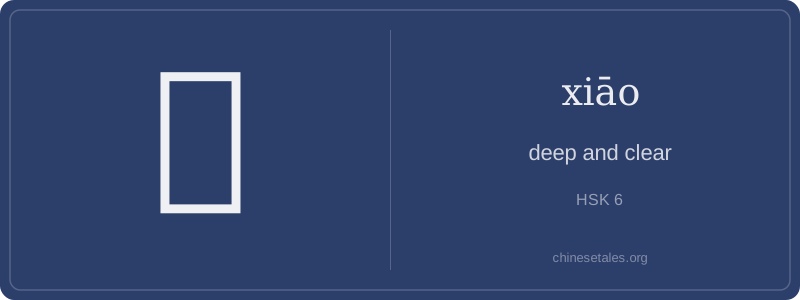
The earliest form of 潇 appears in seal script as a flowing water radical (氵) paired with a phonetic component 肅 (sù), which originally depicted hands holding ritual vessels — suggesting solemnity and order. Over time, 肅 simplified to 肃, and its lower part morphed into the distinctive ‘X’-shaped crossbar + dot combo at the bottom of modern 潇. Visually, the three water dots pulse leftward, while the right side’s sharp angles and descending strokes mimic the controlled yet fluid motion of a mountain stream carving through stone — not chaotic, but purposefully clear.
This visual logic anchored its meaning: not just physical clarity, but moral and aesthetic purity. By the Tang dynasty, poets like Du Fu used 潇湘 to evoke both geographic reality and emotional depth — the rivers became metaphors for unspoken grief and enduring elegance. The character’s structure — water + disciplined form — quietly encodes a core Chinese ideal: clarity isn’t emptiness; it’s clarity *achieved through refinement*, like ink washed over rice paper until only essential lines remain.
At its heart, 潇 isn’t just ‘deep and clear’ — it’s the poetic weight of water that feels *alive*: clear enough to see the pebbles, deep enough to hold silence, and moving with effortless grace. Native speakers don’t use it for tap water or swimming pools; it’s reserved for landscapes (a 潇湘 river), moods (a 潇洒 person), or literary atmosphere — evoking quiet profundity, not clinical clarity. Think of it as ‘clarity with soul.’
Grammatically, 潇 almost never stands alone. It’s nearly always paired: in compounds like 潇洒 (xiāo sǎ, 'uninhibited and elegant') or 潇湘 (xiāo xiāng, the famed Hunan rivers). You’ll rarely see it as a verb or adjective by itself — unlike 清 (qīng, 'clear'), which can modify nouns directly (清水, 'clear water'). Learners often mistakenly insert 潇 before nouns ('*潇水') — but it only works in fixed, classical-tinged phrases.
Culturally, 潇 carries Han dynasty literati DNA: it’s tied to the Xiang River region where exiled poets like Qu Yuan wrote melancholy masterpieces. That’s why 潇湘 isn’t just geography — it’s shorthand for refined sorrow and natural beauty entwined. A common error? Confusing it with 瀟 (the traditional variant — same sound/meaning, but different stroke order and rare in mainland usage). Also, don’t force it into modern bureaucratic contexts — it would sound absurdly ornate in a weather report!