灌
Character Story & Explanation
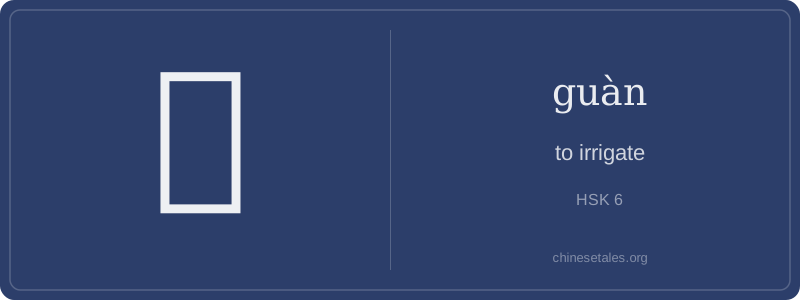
The earliest form of 灌 appears in Warring States bamboo slips as a compound pictograph: three water drops (氵) on the left, and on the right, a stylized vessel (缶 fǒu) with a hand (又 yòu) pouring liquid downward — sometimes with droplets falling into a basin. Over time, the right side evolved: the vessel merged with the hand and added a phonetic component 友 (yǒu), which later morphed into 雚 (guàn), a rare bird-shaped phonetic that gave the character its sound. By the Han dynasty, the shape stabilized into today’s 20-stroke structure: 氵 + 雚, where the upper part of 雚 resembles two birds watching — a whimsical echo of vigilance needed in water management.
This visual logic persisted through history: the *Shuōwén Jiězì* (121 CE) defines 灌 as 'to pour water onto fields' — emphasizing land cultivation. In Tang poetry, it appears in agrarian odes; by the Ming-Qing era, its metaphorical use exploded: Confucian scholars spoke of 灌輸道德 (guànshū dàodé, 'infusing moral principles'), linking hydraulic control to pedagogical authority. Even today, the character’s shape quietly reminds us: wisdom, like water, must be guided — not dumped.
At its heart, 灌 (guàn) is about controlled, purposeful flow — not just any water, but water directed with intention: into fields, into pipes, even into ears or minds. Think of it as the verb of 'channeling' rather than 'pouring.' That’s why it rarely appears in casual contexts like 'I poured tea' (that’s 倒 dào); instead, 灌 implies scale, system, and function — irrigation networks, infusion therapy, or even figuratively 'flooding' someone with information ('灌输 guànshū').
Grammatically, 灌 is transitive and often takes a directional complement or resultative suffix. You’ll see it in patterns like 灌满 (guàn mǎn, 'fill completely by pouring in'), 灌溉 (guàngài, 'irrigate'), or in passive constructions like 水被灌入渠道 (shuǐ bèi guàn rù qúdào, 'water was channeled into the canal'). A classic learner trap? Using 灌 where 倒 or 浇 (jiāo) fits better — e.g., saying *我灌了杯茶* sounds like you’re pressurizing tea into a reservoir!
Culturally, 灌 carries quiet weight: it evokes ancient hydraulic engineering — from Dujiangyan’s 2,200-year-old flood control system to modern agricultural policy. In classical texts, it appears in technical contexts (e.g., the *Book of Han*) describing state-managed water distribution. Interestingly, its extended meanings — 'instill,' 'infuse,' 'inject' — reveal how deeply Chinese thought links physical nourishment with intellectual or moral cultivation.