炎
Character Story & Explanation
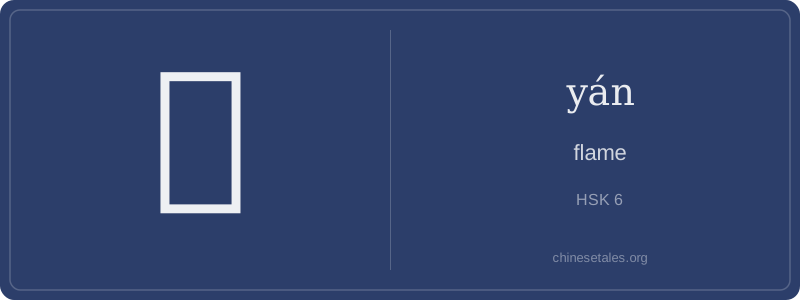
The earliest form of 炎 appears in oracle bone inscriptions as two stacked, simplified 火 (fire) glyphs — each a stylized upward flicker with three dots representing sparks. Over centuries, the lower fire lost its left dot and the upper fire compressed its strokes, merging into the elegant, symmetrical double-fire we know today: two identical 火 radicals sharing the same vertical axis. Crucially, this wasn’t just duplication — it was *layered representation*: the top fire rising *from* the base of the bottom fire, suggesting sustained, self-fueling combustion — a visual metaphor for intensity and continuity.
This doubling shaped its meaning profoundly. In the *Shuōwén Jiězì* (121 CE), Xu Shen defined 炎 as ‘flames rising high’ (火光上也), emphasizing vertical surge and luminous power — not mere ignition. By the Tang dynasty, poets like Li Bai used 炎光 to evoke celestial radiance, while medical texts like the *Huangdi Neijing* employed 炎 to describe pathological ‘excess fire’ in the body — a concept still central to Traditional Chinese Medicine. The character’s visual symmetry mirrors its semantic duality: both destructive and vital, external blaze and internal fever — fire as force, not fuel.
Imagine standing before an ancient bronze altar in Shang dynasty ritual — not one flame, but two roaring, synchronized tongues of fire leaping upward from the same hearth. That’s 炎: not just ‘flame’ as a generic noun, but *intensified, doubled fire* — heat that radiates, blazes, and consumes with layered energy. In modern Chinese, 炎 rarely stands alone as a noun (you’d say 火 or 火焰 instead); it’s almost always a semantic engine inside compound words, especially those denoting inflammation, fever, or fiery intensity — think 炎症 (inflammation) or 炎热 (scorching heat). Its presence signals escalation: where 火 is the spark, 炎 is the wildfire.
Grammatically, 炎 is never used as a verb or standalone subject/object in speech — a common learner trap. Saying *‘wǒ hěn yán’* (I am very flame) makes zero sense; instead, you’ll see it powering adjectives like 炎热 (yán rè — sweltering), nouns like 肺炎 (fèi yán — pneumonia), or even poetic metaphors like 炎光 (yán guāng — blazing light). It carries an inherent weight: it implies *systemic*, *internal*, or *pathological* heat — not the cozy glow of a candle.
Culturally, 炎 resonates beyond physics: it’s in the name of the legendary Yan Emperor (Yán Dì), one of China’s mythical founders associated with fire, agriculture, and medicinal knowledge — linking flame to healing and civilization. Learners often misread it as ‘fire + fire = more fire’, missing its deeper nuance: it’s not additive, but *amplifying* — like resonance, not repetition. And yes, its double-fire shape literally echoes that idea: two flames feeding off each other, not side by side.