炫
Character Story & Explanation
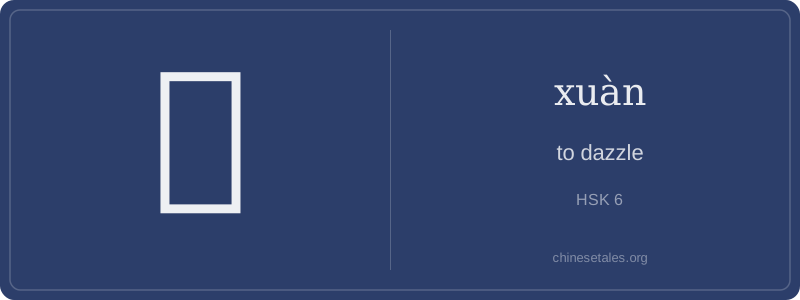
The earliest form of 炫 appears in bronze inscriptions as a combination of 火 (fire) on the left and 玄 (xuán, ‘profound/dark’) on the right — not as a pictograph of flame, but as a *semantic-phonetic compound*. 玄 originally depicted interwoven threads (like deep, dark silk), and its pronunciation (xuán) gave the sound clue for 炫. Over centuries, 玄 simplified visually: its top ‘silk’ component (糸) condensed into two dots and a bent line, while the lower part became the modern 玄 shape we see today — now looking more like a stylized swirl than thread. The fire radical stayed firmly left, anchoring the character’s energetic core.
This visual pairing is brilliantly paradoxical: 玄 means ‘deep, mysterious, dark’, while 火 means ‘bright, hot, visible’ — together, they evoke *light emerging from depth*, like a sudden flare in darkness. By the Han dynasty, 炫 solidified its meaning of ‘dazzle’ or ‘shine brilliantly’, appearing in texts like the Hanshu to describe radiant armor or celestial phenomena. Later, its sense broadened to include ‘showing off’ — a metaphorical extension: just as light draws the eye, conspicuous behavior draws attention. The stroke order (fire first, then 玄) reinforces this: energy precedes expression.
At its heart, 炫 (xuàn) is all about *light that commands attention* — not gentle illumination, but a sudden, showy burst: dazzling sunlight off chrome, a pop star’s sequined jacket under stage lights, or even the overconfident flex of new wealth. The fire radical (火) isn’t just decorative; it signals intense energy, heat, and visibility — this is light with attitude. Unlike neutral verbs like 显示 (to display), 炫 carries strong connotation: it implies *intentional, often excessive, self-promotion*. You don’t ‘炫’ facts in a report; you ‘炫’ your new watch, your child’s award, or your perfect latte art — always with an audience in mind.
Grammatically, 炫 is most commonly used as a transitive verb, taking a direct object (e.g., 炫富 ‘show off wealth’), but it also appears in vivid reduplicative forms like 炫炫的 (xuànxuàn de), meaning ‘flashy’ or ‘glittering’. A frequent learner trap? Using it where English says ‘show’ or ‘display’ without checking tone: 炫富 isn’t ‘wealth display’ — it’s ‘wealth *flaunting*’, often with negative social judgment. Also, it rarely stands alone: you almost never say ‘He xuàn’ — it’s ‘He xuàn his new phone’ (他炫耀新手机).
Culturally, 炫 reflects China’s complex dance with visibility and modesty. Confucian values prize humility, so 炫 often appears in critiques (e.g., ‘don’t be flashy’) — yet social media has turbocharged its usage, especially in youth slang like 炫娃 (xuàn wá, ‘show off one’s kid’). Ironically, the character itself is sleek and minimal (just 9 strokes), while the behavior it names is anything but subtle.