乌
Character Story & Explanation
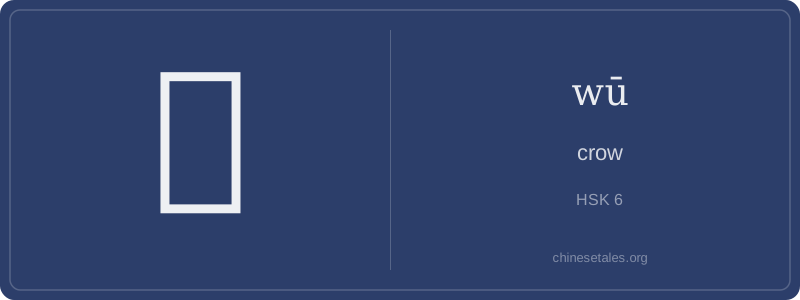
The earliest form of 乌 appears on Shang dynasty oracle bones as a highly detailed pictograph: a bird with head, wings, tail, and two legs — but crucially, *no eyes*. Yes — unlike most bird characters (like 鸟 niǎo), the ancient scribes deliberately omitted the eye to distinguish the crow from other birds, perhaps reflecting an observation that crows’ dark plumage made their eyes hard to see against their feathers. Over centuries, strokes simplified: wings merged, legs shortened, and the eyeless head became a simple dot or short stroke above — evolving into today’s four-stroke 乌: 丿 (beak), 一 (head), ㇇ (body curve), and 丶 (the ‘eye-less’ dot).
This intentional absence became semantic destiny. By the Han dynasty, 乌 was already used metaphorically for ‘black’ — not because crows are black (they are), but because their ‘eyeless’ form suggested darkness, obscurity, and depth. In the Classic of Poetry, 乌 appears in lines evoking dusk and solemnity. Its lack of an eye wasn’t a flaw — it was a philosophical statement: true essence lies not in surface detail, but in silhouette, shadow, and resonance.
At first glance, 乌 (wū) means 'crow' — but don’t imagine a noisy park bird. In Chinese, the crow is culturally loaded: it’s not ominous like in Western folklore, but revered for filial piety — legend says young crows feed their aging parents, making 乌 a subtle symbol of loyalty and duty. That’s why it appears in classical phrases like 乌鸟私情 (wū niǎo sī qíng), meaning 'the private affection of a crow,' i.e., deep, humble filial love.
Grammatically, 乌 is rarely used alone today — you’ll almost never say *‘There’s a wū on the roof.’* Instead, it thrives in compounds (like 乌鸦 wūyā, ‘crow’) or as a poetic/ literary stand-in for ‘black’ (e.g., 乌云 wūyún, ‘dark clouds’). Learners often mistakenly use 乌 as a general adjective for ‘black,’ but that’s wrong — 黑 (hēi) is the everyday word; 乌 is literary, evocative, and almost always appears in fixed expressions or imagery.
Culturally, 乌 also carries quiet irony: though it depicts a black bird, its oracle bone form had no color — just shape. Over millennia, its association with blackness emerged *after* the visual simplification, not before. A classic learner trap? Using 乌 instead of 呜 (wū, ‘to cry out’) — they sound identical but share zero meaning. And yes, that tiny 丿 radical? It’s not decorative — it’s the crow’s downward-curved beak, frozen in ink for 3,200 years.