烘
Character Story & Explanation
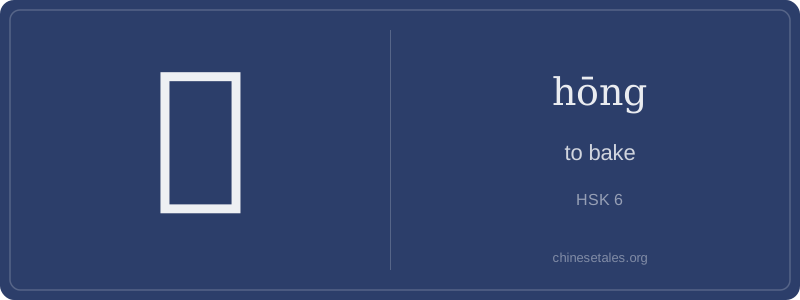
The earliest form of 烘 appears in seal script as two fire radicals (火) flanking a phonetic component 哄 (hōng, now obsolete), suggesting 'heat surrounding something.' In oracle bone inscriptions, though rare, scholars reconstruct it from related characters showing flames beneath a covered vessel — visualizing steam trapped under a lid during drying. Over centuries, the left 火 radical stabilized, while the right evolved from 哄 into 共 (gòng, 'together'), retaining the 'encircling heat' idea. By the Han dynasty, the modern 10-stroke structure crystallized: 火 (fire) + 共 (together) = heat applied collectively and evenly.
This visual logic shaped its semantic journey: from literal kiln-firing in bronze-casting texts (like the *Rites of Zhou*) to Tang-dynasty poetry where 烘 was used metaphorically — Du Fu wrote of clouds 'baking' the mountains (云烘山, yún hōng shān), evoking radiant, atmospheric warmth. Even today, the shape whispers its meaning: fire working *in concert* (共) — never alone, never violent, always collaborative and methodical.
At its heart, 烘 is about controlled heat — not the wild blaze of 火 (huǒ) itself, but the gentle, enveloping warmth of baking, drying, or even metaphorical 'heating up' of emotions or atmospheres. The character radiates a sense of deliberate, sustained thermal energy: think oven-baked buns, sun-dried tea leaves, or a room warmed by anticipation. Its core feeling is *transformation through steady heat* — not destruction, but refinement.
Grammatically, 烘 is almost always a transitive verb requiring an object (e.g., 烘面包, 烘干衣服), and it frequently appears in compound verbs like 烘烤 (hōng kǎo, 'to bake') or passive constructions like 被烘得暖暖的 ('warmed thoroughly'). Learners often mistakenly use it for grilling (which is 烤 or 煎) or boiling — but 烘 implies dry heat, no liquid involved. It also appears idiomatically: 烘托 (hōng tuō, 'to set off/contrast') borrows the idea of surrounding something with warmth to highlight it — like lighting around a stage actor.
Culturally, 烘 carries quiet craftsmanship: traditional paper-making (烘纸), porcelain firing (烘坯), and even tea processing (烘青) all rely on precise, low-intensity heating. A common slip? Using 烘 instead of 晒 (shài, 'to sun-dry') — but 烘 is artificial or enclosed heat; 晒 is solar and open-air. Also, note that while 烘 can mean 'to warm up' literally, saying 我烘一下 (wǒ hōng yí xià) sounds odd — you’d say 我烤一下 or 我暖和一下. It’s a verb that insists on purpose and process.