烹
Character Story & Explanation
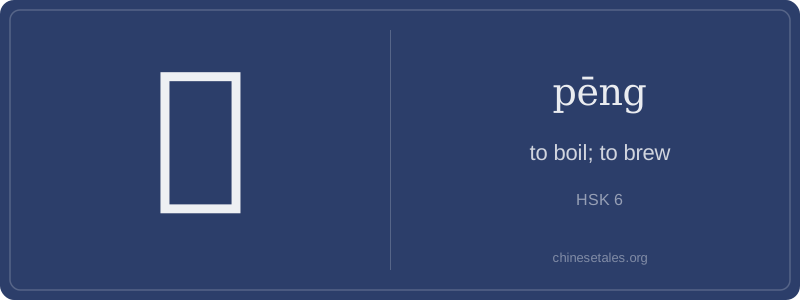
The earliest form of 烹 appears in bronze inscriptions as a compound pictograph: a pot (represented by a vessel shape) atop a fire (灬), with a hand (又) holding a ladle or stirring implement. Over centuries, the vessel simplified into the top component 亨 (hēng, originally meaning ‘to pass through smoothly’ — hinting at ideal heat flow), while the fire radical 㷉 evolved into the standardized four-dot bottom 灬. The hand element vanished, but its action remains implied in the character’s semantic weight: active, skilled intervention with flame.
This visual logic shaped its meaning: not passive boiling, but purposeful, skillful application of fire to transform ingredients. By the Warring States period, 烹 appeared in texts like the *Zuo Zhuan*, describing ritual food preparation for nobles. Its most famous — and chilling — usage is in the phrase 烹刑 (pēng xíng), ‘the cauldron punishment’, a brutal execution method referenced in Sima Qian’s *Records of the Grand Historian*. Yet paradoxically, 烹 also became associated with refinement: Mencius praised rulers who ‘governed like one 烹 soup’ — balancing ingredients (people) with wisdom and heat (authority).
At its heart, 烹 isn’t just ‘to boil’ — it’s the art of transformation through fire: raw to ready, chaotic to controlled. In Chinese culinary philosophy, 烹 implies intentionality and technique, not mere heating. You don’t 烹 water (that’s 烧 or 煮); you 烹 a dish — say, 烹虾 (pēng xiā) — evoking the sizzle, timing, and mastery behind a perfectly seared prawn. It carries a subtle prestige: this is cooking as craft, not chore.
Grammatically, 烹 is almost always transitive and formal — rarely used in casual speech. You’ll find it in recipes, restaurant menus, classical allusions, and literary metaphors (e.g., 烹茶, ‘to brew tea’ with ritual precision). Learners often overuse it like English ‘cook’, but native speakers reserve it for contexts where fire and finesse converge — never for microwaving leftovers! Also note: it’s never used in progressive aspect (no *正在烹); instead, it appears in perfective or descriptive constructions like 已经烹好 or 烹制精良.
Culturally, 烹 reflects the ancient Confucian ideal of harmony-through-process: heat must be applied just so — too little, no change; too much, ruin. That’s why it appears in idioms like 烹龙炮凤 (pēng lóng pào fèng), ‘boiling dragons and roasting phoenixes’ — hyperbolic imagery for extravagantly refined cuisine. A common mistake? Confusing it with 煮 (to boil simply) or 炒 (to stir-fry); 烹 is broader, older, and more ceremonious — think imperial kitchen, not dorm-room pot.