烁
Character Story & Explanation
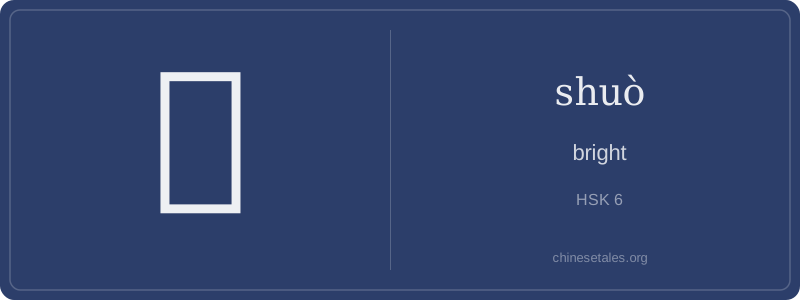
The earliest form of 烁 appears in seal script (around 200 BCE), where it clearly combines 火 (huǒ, fire) on the left — drawn as three flickering flames — with 乐 (lè, music/joy) on the right. But here’s the twist: 乐 wasn’t chosen for meaning — it was borrowed for its *sound*. Ancient Chinese scribes used phonetic loan characters extensively, and 乐 happened to be pronounced similarly to the intended word for ‘glitter’. Over centuries, the right side simplified: the top ‘white’ component (白) of 乐 blurred into the ‘crown’ shape (⺌), and the bottom ‘wood’ (木) became the two dots and a stroke — evolving into today’s 乐-derived right-hand structure. Visually, it’s fire + shimmering resonance.
This phonetic borrowing explains why 烁 has no semantic link to ‘music’ — yet its origin whispers of harmony: light and sound both vibrating at high frequencies. In the Shījīng (Book of Songs), early variants of 烁-like forms describe stars ‘leaping’ in the night sky — not shining steadily, but winking into view. By the Tang dynasty, poets like Li Bai used 烁 to capture lightning splitting clouds or sword blades catching sun — always with kinetic energy. The character doesn’t depict light itself; it depicts light *in motion*, echoing how ancient minds linked luminosity with vitality, rhythm, and sudden insight.
At its heart, 烁 (shuò) isn’t just ‘bright’ — it’s *flickering* brightness: the sudden, sharp, almost electric gleam of light breaking through darkness. Think lightning in a storm, stars piercing thin clouds, or sparks flying from struck flint. That’s why it’s never used for steady, calm light (that’s 明 or 亮); 烁 always implies motion, transience, and intensity — a visual gasp. It’s an adjective, but unlike most adjectives in Chinese, it rarely stands alone; it almost always appears in compound words (like 闪烁 or 硕烁) or as part of poetic or literary descriptions.
Grammatically, 烁 rarely functions independently — you won’t say *‘this lamp is shuò’*. Instead, it shines in verbs like 闪烁 (shǎnshuò, to flicker) and nouns like 烁烁 (shuòshuò, glittering brilliance). It’s also common in classical-style expressions and formal writing — a hallmark of HSK 6 fluency. Learners often misapply it like English ‘bright’, leading to unnatural phrasing. Remember: if the light isn’t dancing, pulsing, or flashing, don’t reach for 烁.
Culturally, 烁 carries a subtle sense of awe or fragility — that brilliance is fleeting, even dangerous. In classical poetry, it often evokes celestial wonder or momentary revelation. A common pitfall? Confusing it with 硕 (shuò, ‘large’) — same sound, totally different meaning and radical. Also, note that 烁 is *never* used in everyday spoken Mandarin for ‘bright’ — that’s 亮 or 明. Its power lies precisely in its rarity and precision: it’s the scalpel, not the flashlight.