牢
Character Story & Explanation
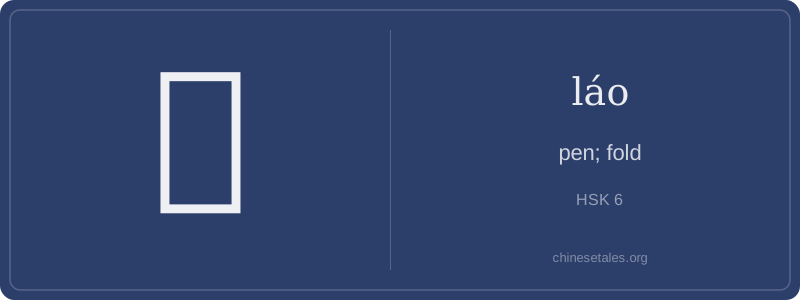
Oracle bone inscriptions show 牢 as a simple pictograph: a square enclosure (冖, representing a roof or cover) with a cow (牛) inside — literally 'a covered pen for cattle'. Over time, the roof evolved into the top component 冖 (mì, 'cover'), the cow radical 牛 settled at the bottom, and the middle stroke became standardized as 丿 — all seven strokes now forming a compact, cage-like shape. Bronze script added slight curving flourishes, but kept the core idea unmistakably pastoral and functional.
By the Warring States period, 牢 expanded beyond livestock: bamboo slips record it describing secure storage pits for grain, then metaphorically for 'unshakeable loyalty' in texts like the Zuo Zhuan. Mencius even used 牢 to describe moral resolve — 'the mind must be 牢 like an ox-pen, not easily breached by temptation.' The visual logic remained constant: containment → security → endurance. That ancient cow pen didn’t just hold animals — it became the blueprint for mental fortitude.
At its heart, 牢 (láo) evokes confinement—not just physical pens for cattle, but the psychological weight of being firmly held in place: a牢骚 (láosāo, 'gripe') is a complaint that’s been stewing too long; 牢固 (láogù, 'solid') describes something so tightly anchored it won’t budge. It carries quiet intensity—never violent, but deeply rooted, like roots gripping bedrock.
Grammatically, 牢 rarely stands alone as a noun today (you’d say 羊圈 yángquān for 'sheep pen'), but shines as a bound morpheme: 牢记 (láo jì, 'memorize firmly'), 牢靠 (láo kào, 'reliable'), and even the verb phrase 牢住 (láo zhù, 'to secure firmly'). Note: it’s never used for human imprisonment—that’s 监狱 (jiānyù) or 牢房 (láofáng), where 牢 is already fossilized in compound form. Learners often mistakenly use 牢 as a standalone word meaning 'prison'—but in modern speech, you’ll almost always hear it paired.
Culturally, 牢 embodies Confucian ideals of steadfastness: loyalty (忠牢? no—but 忠诚 zhōngchéng echoes the same root idea), reliability, and unshakable principle. Its radical 牛 (niú, 'cow') reminds us that this strength isn’t flashy—it’s patient, grounded, and built to last. A common slip? Writing 牢 instead of 老 (lǎo, 'old')—they sound similar, but mixing them turns 'firmly remember' into 'old remember', which makes zero sense!