狠
Character Story & Explanation
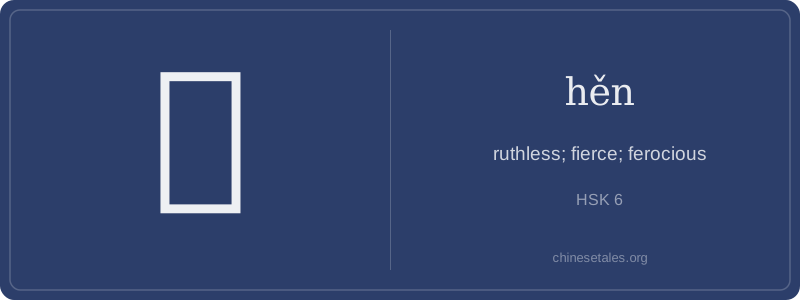
The earliest form of 狠 appears in seal script (c. 3rd century BCE), built from the ‘dog’ radical 犭 on the left — representing wildness, instinct, and predatory alertness — and the phonetic component 禾 (hé, ‘grain’) on the right. Wait — grain? Yes! But here, 禾 wasn’t chosen for meaning; it was borrowed purely for its sound (hé → hěn), while the radical 犭 anchored the semantic field: sharp, untamed, dangerous. Over time, 禾 simplified into the modern right-hand component (彐 + 一 + 丶), losing its agricultural look but keeping its phonetic role — a classic case of sound-over-sense evolution.
This character first appeared in texts like the Shuōwén Jiězì (121 CE), defined as ‘ferocious, fierce, cruel’ — always tied to volition and intent, not mere emotion. By the Tang dynasty, poets used it to describe unyielding loyalty (e.g., ‘心狠志坚’ — ‘heart fierce, will unbreakable’), cementing its link to moral rigor. Visually, the three strokes of 犭 suggest claws or bared teeth; the compact right side feels like a clenched jaw — together, they form a portrait of restrained, dangerous resolve.
At its core, 狠 isn’t just ‘ruthless’ — it’s the visceral *intensity* behind a decision: the cold focus of a strategist, the unblinking resolve of someone who won’t back down, or the raw edge in a person’s voice when they’ve had enough. It’s not mindless violence; it’s controlled ferocity — think ‘sharp as a wolf’s gaze’, not ‘blind rage’. That’s why it pairs naturally with verbs like 下决心 (xià juéxīn, ‘to make a firm decision’) or 打击 (dǎjī, ‘to strike’): 狠下决心 (hěn xià juéxīn) literally means ‘to ruthlessly commit to a decision’ — and yes, that ‘ruthlessly’ is actually positive here!
Grammatically, 狠 shines as an adverb meaning ‘extremely’ or ‘very’ — but only in spoken, colloquial Mandarin (e.g., 这事太狠了! — Zhè shì tài hěn le! — ‘This situation is *brutally* intense!’). Crucially, it’s never used before adjectives like 好 or 大 the way 很 is — saying 狠好 is grammatically wrong and will make native speakers blink. Learners often overgeneralize from its adverbial use and forget its primary role as an adjective describing moral intensity or emotional severity.
Culturally, 狠 carries layered weight: in classical texts, it described the unwavering resolve of loyal ministers; today, it’s also used playfully among friends — ‘你这操作太狠了!’ (Nǐ zhè cāozuò tài hěn le!) — praising someone’s impressively bold move in gaming or negotiation. The trap? Assuming it’s always negative. In fact, its fiercest usage is often admirable — because in Chinese, true strength isn’t gentle; it’s focused, decisive, and unflinching.