猛
Character Story & Explanation
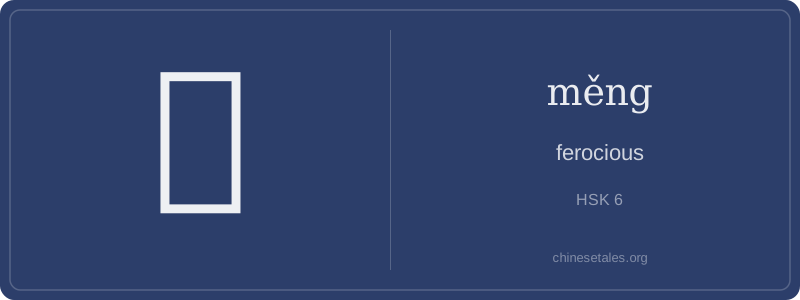
The earliest form of 猛 appears in bronze inscriptions as a combination of 犭 (quǎn, ‘dog’ radical, representing wild animals) and 艮 (gèn), a phonetic component meaning ‘to stop’ or ‘to restrain’ — but visually, 艮 looked like a person kneeling with arms crossed, suggesting tension about to snap. Over centuries, 艮 simplified into the top-right 4-stroke shape we see today, while the left 犭 solidified into its modern three-stroke ‘running dog’ form — evoking motion, urgency, and untamable instinct.
This visual tension — animal energy + pent-up restraint — perfectly seeded its semantic evolution. In the Shuō Wén Jiě Zì (121 CE), 猛 was defined as ‘fierce, bold, daring’, applied first to warriors and hunting beasts. By the Tang dynasty, poets like Du Fu used it metaphorically: ‘猛风’ (měng fēng, ‘raging wind’) wasn’t just strong wind — it was wind that shattered composure. The character’s structure itself became a lesson: the ‘dog’ radical on the left charges forward, while the ‘restraint’ component above seems to brace — yet the whole character reads as explosive release. That duality — control *just before* eruption — remains central to its modern feel.
At its core, 猛 isn’t just ‘ferocious’ — it’s the visceral, almost physical sensation of sudden, overwhelming force: a tiger lunging, a storm breaking, or a surge of emotion so intense it overrides reason. Chinese speakers use it to describe raw power that’s untamed and immediate — not evil, but uncontainable. It carries a slight awe, even respect; calling someone 猛将 (měng jiàng) isn’t an insult — it’s praising their fearless battlefield energy.
Grammatically, 猛 is almost always an adjective or adverb — but crucially, it rarely stands alone. You won’t say *‘He is 猛’*; instead, you’ll say 猛烈 (měng liè, ‘intense/fierce’) or use it adverbially: 猛地 (měng de, ‘suddenly, with jolt’). That little ‘de’ particle? It’s essential — omitting it turns a natural phrase into something awkward or archaic. Learners often mistakenly treat 猛 like English ‘ferocious’ and try to use it predicatively (e.g., *‘This dog is 猛’*), but native speakers would say 这狗很凶 (zhè gǒu hěn xiōng) or, more idiomatically, 这狗特别猛 (zhè gǒu tè bié měng) — where 特别 softens the abruptness.
Culturally, 猛 reflects a deep-rooted appreciation for dynamic, eruptive energy — think of martial arts forms exploding from stillness, or calligraphy strokes that begin with restrained pressure then burst forth (the ‘leap’ in 猛 mirrors that very stroke rhythm). It’s also subtly gendered: 猛 is frequently used for male bravery (猛男, měng nán) but rarely for women — where 果敢 (guǒ gǎn, ‘decisive’) or 霸气 (bà qì, ‘overwhelming charisma’) fill the gap. Misusing 猛 here can unintentionally sound crude or reductive.