狱
Character Story & Explanation
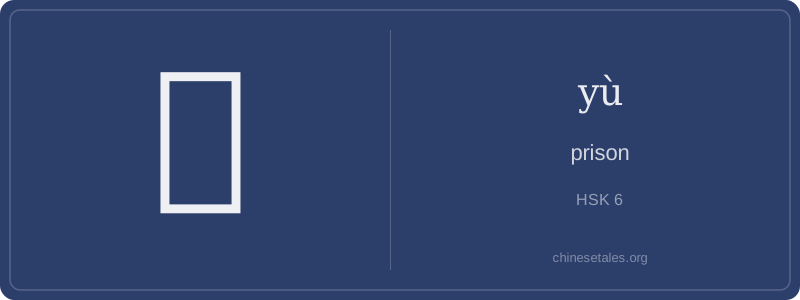
The earliest form of 狱 appears in bronze inscriptions of the Western Zhou (c. 1046–771 BCE) as a complex pictograph: at the top, a stylized ‘dog’ (犭), beneath it two ‘words’ (言), and below that, a ‘net’ (罒) or ‘cover’ (宀) enclosing a ‘person’ (人). This wasn’t literal — it was a *pun-based ideograph*: the dog radical signaled the sound (ancient *ŋʷrək*, related to 狱’s modern *yù*), while the double ‘words’ emphasized accusation and testimony, and the enclosure represented confinement. Over centuries, the double 言 simplified into a single 言, then further eroded into the current 十+口 shape under 犭, and the lower net/roof merged into the 9th stroke — the final downward sweep.
This character crystallized during the Warring States period as states codified laws: 狱 didn’t just mean ‘prison’ — it meant the *entire judicial process*: accusation, interrogation, verdict, and confinement. In the *Zuo Zhuan*, we read of officials ‘决狱’ (*jué yù*) — ‘resolving the case’, where 狱 stood for the contested matter itself. Even today, the compound 冤狱 preserves this dual sense: not just ‘wrongful imprisonment’, but ‘a wrongful judicial outcome’. Its visual architecture — dog (sound clue), words (procedural core), and enclosure (consequence) — makes it one of Chinese’s most semantically dense legal characters.
Imagine a tense courtroom scene in ancient Chang’an: a magistrate slams his wooden gavel, and two guards drag a trembling suspect toward a heavy iron-bound gate — not just any gate, but the yù, the official prison compound where justice is enforced, not debated. That’s the visceral weight of 狱: it’s never casual or metaphorical like ‘jail’ in English — it carries bureaucratic gravity, legal finality, and institutional authority. You’ll see it almost exclusively in formal, written, or historical contexts: court documents, news reports on corruption trials, or classical allusions.
Grammatically, 狱 is a noun that rarely stands alone — it nearly always appears in compounds (like 监狱 or 冤狱) or after classifiers (一座狱, though rare) or verbs indicating containment (入狱, 坐狱, 越狱). Crucially, it’s *not* used for temporary detention — that’s 拘留所 (jūliú suǒ). Learners often mistakenly say *wǒ qù yù lǐ* (“I go to prison”) as if it were a place you visit; native speakers would say *jìn yù* (enter prison) or *zuò yù* (serve time), emphasizing irreversible consequence.
Culturally, 狱 evokes layered connotations: Confucian ideals of moral correction, Legalist rigor, and lingering folk fears of wrongful imprisonment (hence the compound 冤狱 — ‘unjust prison sentence’). It also appears in idioms like 狱讼繁兴 (yù sòng fán xīng), describing societal decay when lawsuits and prisons multiply. A common error? Using 狱 instead of 监狱 in speech — natives say 监狱 almost exclusively; 狱 alone sounds archaic or literary, like saying ‘gaol’ instead of ‘jail’ in modern English.