出
Character Story & Explanation
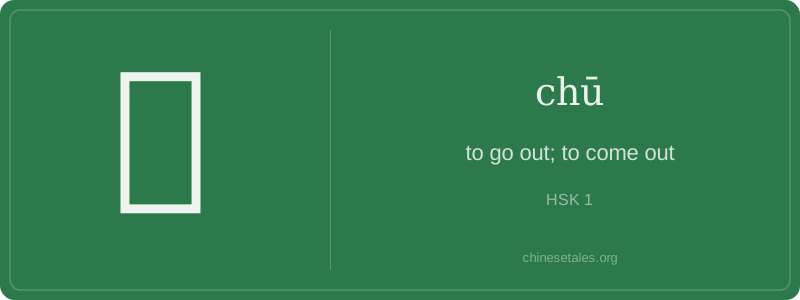
Carve this image in your mind: an oracle bone inscription from 3,000 years ago showing two overlapping footprints (the top two strokes: 丨 and 丨) stepping *out of* a shallow pit or container (the radical 凵, pronounced kǎn, meaning 'hollow' or 'open mouth-shaped vessel'). That pit wasn’t decorative — it was literal: ancient people stored grain or ritual offerings in earthen pits, and 'going out' meant stepping up and over that rim. Over centuries, the footprints simplified into two parallel vertical strokes, the pit became the clean, open-bottomed 凵, and the whole character stabilized at five strokes — a perfect visual metaphor for emergence.
This pictorial logic held firm through bronze inscriptions and seal script. By the Han dynasty, 出 already appeared in texts like the Shuōwén Jiězì dictionary, defined as 'to proceed from within'. Confucius used it in the Analects (16.1) when urging scholars to 'speak after careful thought, and act only after thorough preparation' — implicitly framing action as 'stepping out' of contemplation. Even today, its shape whispers that same ancient truth: before anything appears, it must first rise from containment.
At its heart, 出 (chū) is all about movement across a boundary — not just physical 'going out', but emerging, appearing, producing, or even releasing something latent. Think of it as the Chinese verb for crossing thresholds: stepping out a door, sunlight breaking through clouds, or an idea suddenly surfacing in your mind. Its core energy is dynamic and directional — always outward, always from inside to outside.
Grammatically, 出 loves company: it rarely stands alone. You’ll see it paired with verbs like 来 (lái, 'to come') → 出来 (chūlái, 'to come out'), or 去 (qù, 'to go') → 出去 (chūqù, 'to go out'). It also acts as a resultative complement — a tiny grammatical engine that changes meaning: 吃 (chī, 'eat') + 出 → 吃出 (chī chū, 'eat until something emerges', e.g., 'eat out a flavor'). Learners often mistakenly use 出 alone where English says 'leave' — but you need 出去 or 出来 depending on direction.
Culturally, 出 carries subtle weight: 出名 (chūmíng, 'become famous') implies rising into public view; 出差 (chūchāi, 'go on business trip') signals stepping out of routine duty. A classic mistake? Confusing 出 with 上 (shàng, 'up') or 入 (rù, 'enter') — but here’s the key: 出 isn’t about elevation or inward motion; it’s about *exiting* a defined space or state. Even in modern slang, 出圈 (chū quān, 'exit the circle') means 'go viral' — literally bursting beyond your usual audience.