唱
Character Story & Explanation
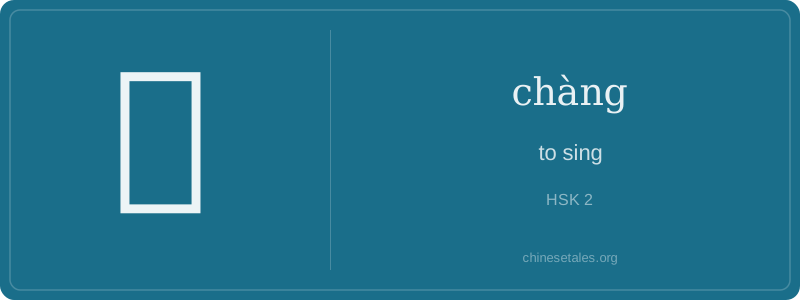
The earliest form of 唱 appears in bronze inscriptions as a combination of 口 (kǒu, 'mouth') and 昌 (chāng, originally two suns stacked, symbolizing brightness and flourishing sound). In oracle bone script, 昌 was drawn as two 日 (rì, 'sun') characters stacked vertically — evoking radiant, resonant vibration. Over centuries, the top sun simplified into 曰 (yuē, 'to speak'), then further stylized into the modern upper component — two horizontal strokes, a dot, and a short slanted stroke — preserving the idea of *luminous, projected voice*. The 口 radical stayed firmly at the left, anchoring the character’s core meaning: vocalization.
This visual logic held strong through history: in the Shījīng (Book of Odes), 唱 appears in contexts of ritual chanting and paired singing (e.g., 唱和 — chàng hè, 'call-and-response'). By the Tang dynasty, it fully denoted melodic singing, distinguishing it from spoken recitation. Even today, the character’s shape whispers its origin: a mouth (口) giving forth bright, clear sound (the upper part echoing 昌’s radiance) — not just noise, but *voice made luminous*.
At its heart, 唱 (chàng) isn’t just ‘to sing’ — it’s the *intentional, voiced performance* of melody or words. Unlike generic sound-making, 唱 implies artistry, rhythm, and vocal projection: you 唱 a song, not a whisper; you 唱 in front of people, not hum to yourself. That’s why you’d say 他唱得很好 (tā chàng de hěn hǎo — 'He sings very well'), but never *他唱了一句悄悄话* — for quiet utterances, you’d use 说 (shuō) or 低语 (dīyǔ).
Grammatically, 唱 is a transitive verb that loves direct objects: 唱歌 (chàng gē), 唱京剧 (chàng jīngjù), 唱生日快乐 (chàng shēngrì kuàilè). It also appears in serial verb constructions like 我们一起唱 (wǒmen yīqǐ chàng — 'We sing together') and with aspect particles: 他刚唱完 (tā gāng chàng wán — 'He just finished singing'). A common mistake? Using 唱 where English says 'recite' — but reciting poetry silently is 背 (bèi); only *aloud and melodically* does 唱 apply.
Culturally, 唱 carries warmth and communal energy — think karaoke nights, school choirs, or folk singers at village festivals. Interestingly, in Mandarin, it’s rarely used for birds or phones 'singing' (those are 叫 or 铃声响起); this human-centered focus reflects how deeply voice and performance are tied to identity and expression in Chinese tradition.