问
Character Story & Explanation
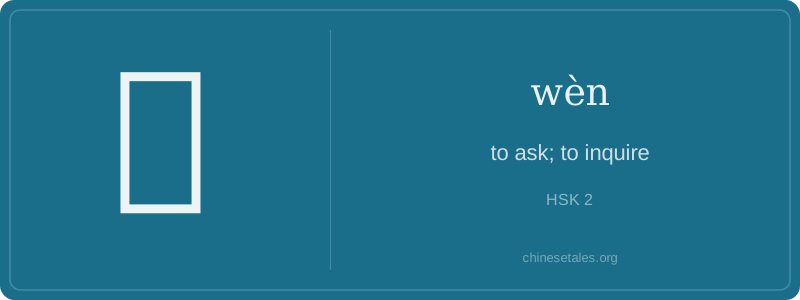
The earliest form of 问 appears in oracle bone inscriptions as a stylized gate (门) with a mouth (口) placed inside — not literally *in* the doorway, but centered beneath its lintel, like a speaker standing at the threshold. This wasn’t a random combo: in ancient China, gates were sites of official inquiry — tax collectors, border guards, and clan elders all stood *at the gate* to question arrivals, verify identities, and gather news. Over centuries, the mouth simplified from a full pictograph to three short horizontal strokes, and the gate’s curved sides straightened into today’s clean 门 frame — six strokes total: two verticals, two horizontals for the top and bottom of the gate, plus two for the mouth inside.
This visual logic held firm through history: 问 remained inseparable from authoritative, face-to-face questioning. In the Analects, Confucius praises Zilu for asking repeatedly until he understood — using 问 each time. Even today, the character evokes that same poised, respectful stance: not barging in, but pausing at the threshold of another’s mind, mouth ready, gate open, waiting for permission to enter.
Think of 问 (wèn) as the Chinese equivalent of raising your hand in a classroom — not just to speak, but to actively seek understanding. Unlike English 'ask', which can be passive ('I asked him for help'), 问 always implies directed, intentional inquiry: you’re opening a door (the 门 radical!) to enter someone else’s knowledge. It’s never used for rhetorical questions or vague wondering — no 'I wonder if...' here. You ask *someone* something: 问老师 (wèn lǎoshī, 'ask the teacher'), 问路 (wèn lù, 'ask directions').
Grammatically, it’s refreshingly straightforward: subject + 问 + person + (optional object). No auxiliary verbs, no tense markers. Just 'I ask you what?' → 我问你什么? (Wǒ wèn nǐ shénme?) And crucially, 问 is never transitive without an indirect object — saying *'wèn a question'* is a classic learner mistake; instead, you ‘ask a question’ using 问题 (wèntí), not 问 directly on its own. The verb does the asking; the noun holds the question.
Culturally, 问 carries quiet respect: asking well is a virtue in Confucian tradition. Over-asking can seem pushy, under-asking may signal disengagement. And beware tone — wèn (fourth tone) sounds sharp and definite; mispronouncing it as wēn (first tone) means 'to warm', and wěn (third tone) means 'stable' — two very different vibes at the dinner table!