报
Character Story & Explanation
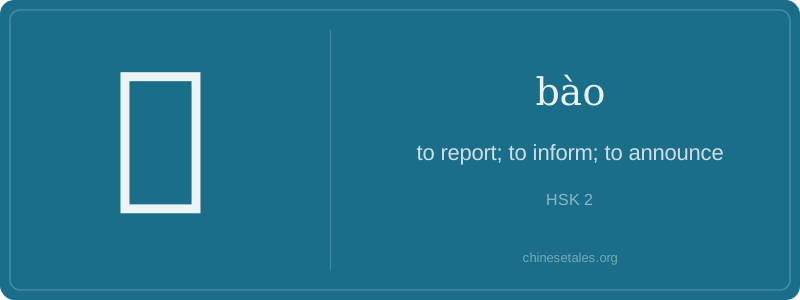
The earliest form of 报 appears in bronze inscriptions around 1000 BCE as a compound: the left side was 手 (hand), and the right was (fù), a pictograph of a bird with spread wings — symbolizing speed and delivery. Over centuries, simplified into 卩 (jié), a seal or tally used in official documents, then further stylized into the modern 又 (yòu) shape we see today. So visually, 报 literally meant ‘to hand-deliver with authority’ — not just speak, but *dispatch with weight*.
This ‘official dispatch’ meaning deepened in classical texts: in the Zuo Zhuan, 报 is used for ‘responding to a ruler’s command’ or ‘repaying a debt of loyalty’. By the Han dynasty, it expanded to include ‘retribution’ (报应 bào yìng — karmic return) and ‘gratitude’ (报恩 bào ēn), showing how deeply Chinese culture links *information*, *action*, and *moral reciprocity*. Even today, the hand radical (扌) reminds us: this is never passive — it’s a deliberate, embodied act.
At its heart, 报 (bào) isn’t just ‘to report’ — it’s about *accountability through communication*. In Chinese thought, reporting isn’t neutral data transfer; it’s a social act that fulfills duty (责任), acknowledges hierarchy (e.g., reporting to a superior), or closes a loop (like repaying kindness — 报恩). That’s why 报 appears in both news (新闻报) and gratitude (报答): the underlying idea is *returning information or favor as an ethical obligation*.
Grammatically, 报 is almost always transitive and needs an object: you 报告 something, 报名 for something, or 报警 about something. Learners often mistakenly use it like English ‘report’ without an object (e.g., *‘I will report’*) — but in Chinese, you must say 报告老师 (bào gào lǎo shī, ‘report to the teacher’) or 报警 (bào jǐng, ‘report an emergency’). It rarely stands alone as an intransitive verb.
Culturally, 报 carries quiet urgency: 报到 (bào dào, ‘check in’) implies timely presence at school or work — missing it isn’t just late, it’s a breach of trust. And watch out: 报 ≠ 说 (shuō, ‘to say’) or 告诉 (gào su, ‘to tell’). While those are casual, 报 feels official, consequential, even solemn — like handing over a sealed letter to the emperor’s court.