番
Character Story & Explanation
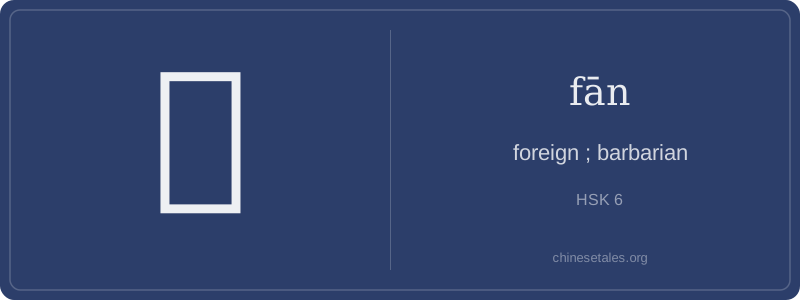
The earliest form of 番 appears on Western Zhou bronze inscriptions as ⿱釆田 — a clear split: above, 釆 (a stylized hand examining a bird’s footprints, symbolizing careful distinction), below, 田 (a bounded field, representing the civilized agricultural core). Over centuries, 釆 simplified into the top component we see today — three horizontal strokes capped by a bent line — while 田 retained its square grid. By the Han dynasty, clerical script smoothed the angles, but the semantic logic remained intact: 'distinguishing what lies outside the field'.
This visual duality shaped its meaning evolution. In the Book of Rites, 番 referred to 'non-Zhou vassal states' — not enemies, but culturally distinct tributaries. By the Tang, 番 became poetic shorthand for the romantic 'Western Regions': 番乐 (fān yuè, Central Asian music) filled Chang’an taverns, and 番僧 (fān sēng, Buddhist monks from India) translated sutras. Crucially, the character never lost its observational, almost bureaucratic nuance — it’s less 'barbarian' and more 'designated other', a category created to manage complexity, not express contempt.
Think of 番 not as a slur, but as an ancient Chinese cartographer’s label for 'what lies beyond the fields' — literally. Its radical 田 (field) anchors it in the agrarian heartland of early China, while the top part (釆, pronounced biàn) originally meant 'to distinguish by examining closely'. So 番 is conceptually: 'the foreign lands we observe carefully from our cultivated fields'. It carries scholarly distance, not hatred — like an anthropologist’s notebook, not a warrior’s taunt.
Grammatically, 番 shines in two key ways: first, as a measure word for *occurrences* (e.g., 一番 effort = 'a round/instance of effort'), where it implies cyclical, earnest engagement — never passive. Second, in compound nouns like 番茄 (fānqié, tomato), it signals 'foreign origin', often with historical irony (tomatoes arrived via the Philippines, not directly from Europe). Learners often misread it as purely negative; in fact, modern usage leans neutral or even affectionate ('foreign friend' = 外国朋友, but 番邦 in classical poetry evokes exotic charm).
Culturally, 番 reveals how China mapped difference: not by race, but by ritual and geography. The Tang Dynasty used 番官 (fān guān) for trusted non-Han officials — proof that 'foreign' could mean 'integrated'. A common mistake? Confusing it with 翻 (fān, 'to flip') — same sound, totally different root. Remember: 番 has 田 (fields); 翻 has 扌 (hand). If you’re turning soil, it’s 翻; if you’re observing distant lands from your field, it’s 番.