异
Character Story & Explanation
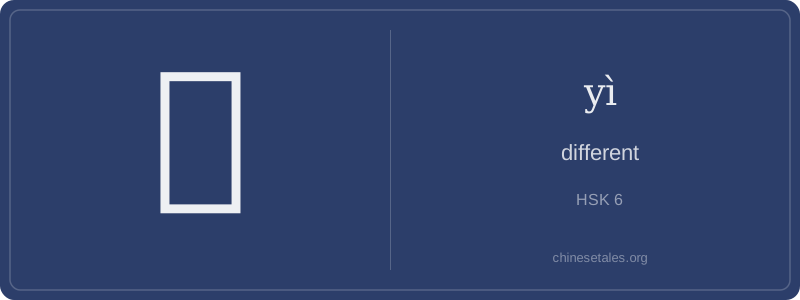
The earliest form of 异, found on Shang dynasty oracle bones, looked like a person with arms raised high — not in surrender, but in ritual display — holding up an object (often interpreted as a ceremonial vessel or perhaps a strange artifact) above their head. Over centuries, this evolved: the top element simplified into 田 (a stylized ‘object’ or ‘field’), while the bottom stabilized into 廾 — two hands cupping upward. By the Han dynasty seal script, the modern shape was nearly complete: 田 atop 廾 — literally ‘an object held aloft by two hands’, evoking something unusual enough to warrant presentation and attention.
This visual origin directly shaped its meaning: what you lift up before others must be noteworthy — foreign, rare, or extraordinary. In the Analects, Confucius uses 异 in phrases like ‘君子不以言举人,不以人废言’ — subtly implying that truth shouldn’t be dismissed just because it comes from someone ‘different’. Later, in Tang poetry, 异 appears in lines describing exotic landscapes or unfamiliar customs — always carrying reverence, not disdain. The character never meant ‘strange’ in a negative sense; rather, it encoded respectful acknowledgment of meaningful divergence — a philosophical stance baked into its very strokes.
Imagine you’re at a bustling Shanghai teahouse where three generations gather — grandma tells stories of old Nanjing, your cousin scrolls TikTok clips from Chengdu, and your uncle sketches calligraphy with ink made from pine soot. In that room, 异 isn’t just ‘different’ — it’s the quiet hum of divergence: not conflict, but respectful, textured variation. That’s the core feel of 异: it carries intellectual or cultural distinction, often with nuance — not random difference (that’s 别 or 不同), but *meaningful*, sometimes even *elegant* divergence.
Grammatically, 异 rarely stands alone as a verb or adjective. Instead, it’s the powerhouse inside compound words (like 差异 or 异常) or formal expressions like 异口同声 (‘with one voice’) — where it adds weight and classical resonance. Learners often mistakenly use 异 as a direct synonym for ‘different’ in casual speech (e.g., saying *tā hěn yì*), but that’s unnatural; you’d say *tā hěn bù tóng*. 异 shines in written, academic, or literary contexts — think policy documents, philosophy essays, or news headlines about cross-strait relations (两岸差异).
Culturally, 异 has subtle prestige: it appears in revered terms like 异端 (‘heresy’, literally ‘different path’) and 异乡 (‘foreign land’ — implying deep cultural distance, not just geography). A common trap? Confusing 异 with 易 (yì, ‘easy’) — same pinyin, totally different roots and vibes. Also, note its radical 廾 (gǒng), meaning ‘cupped hands’ — a visual nod to holding something distinct, respectfully, in your palms.