疆
Character Story & Explanation
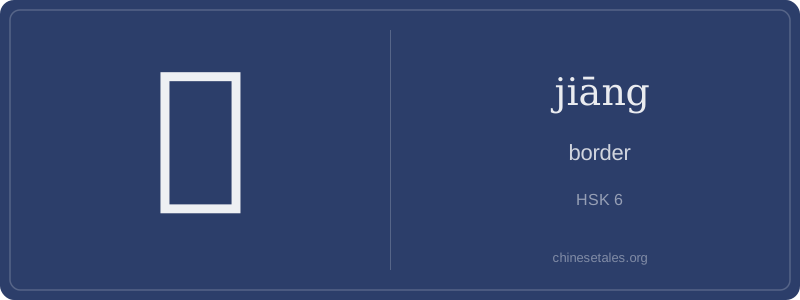
The earliest form of 疆 appears in bronze inscriptions of the Western Zhou (c. 1046–771 BCE) as a complex pictograph: a field (田) crossed by three parallel lines (symbolizing surveyor’s markers or boundary ditches), flanked by two 'strong arms' (彊, later simplified to 强) — representing human effort to define and defend arable land. Over centuries, the arms condensed into the 弓 (bow) + 强 components on the right, while the left retained 田 — making its etymological logic unmistakable: 'land marked and held by strength.'
This visual logic endured: in the Classic of Poetry (Shījīng), 疆 appears in verses like '我疆我理' ('I mark out my borders and organize my fields'), linking territorial definition directly to agricultural administration. By the Han dynasty, it had crystallized into its modern shape — still carrying that ancient tension between cultivation (田) and coercion (强). Even today, when Chinese leaders speak of 守住祖国的每一寸疆土 ('guard every inch of our motherland’s territory'), they’re echoing a 3,000-year-old semantic pact between soil, survey, and sovereignty.
Think of 疆 (jiāng) not just as 'border' but as a *living boundary* — one that’s cultivated, defended, and deeply territorial. Its core meaning evokes the idea of a clearly demarcated, often contested, stretch of land: national frontiers (e.g., 边疆), administrative limits, or even metaphorical boundaries like ideological or disciplinary borders. Unlike generic terms like 界 (jiè), which means 'boundary' in an abstract or geometric sense, 疆 carries weight — it implies sovereignty, control, and historical presence on the soil.
Grammatically, 疆 rarely stands alone; it almost always appears in compounds like 边疆 (frontier region), 新疆 (Xinjiang — literally 'New Borderland'), or 疆域 (territory). You’ll never say *'this is my 疆'* — instead, you’d say 我国的疆域 ('the territory of our country'). It’s a noun-only character with no verb or adjective forms, and learners often mistakenly try to use it like a standalone classifier or adjective (e.g., *'疆大'* — wrong! Use 幅员辽阔 or 面积广大 instead).
Culturally, 疆 is inseparable from China’s imperial expansion and ethnic geography — especially in phrases like 西疆 (Western borderlands) or 汉疆 (Han dynasty’s frontier zones). A common learner trap? Confusing it with 僵 (stiff) due to identical pronunciation and similar right-hand component — but 僵 has 死 (death) on the left, while 疆 has 田 (field), grounding it in land, not posture. Also, note: it’s always pronounced jiāng — never jiàng, even in compound stress contexts.