疤
Character Story & Explanation
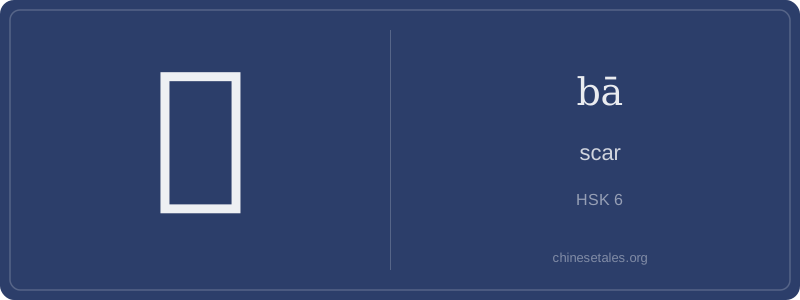
The earliest form of 疤 appears not in oracle bones but in early seal script (c. 3rd century BCE), where it combined the sickness radical 疒 (depicting a person lying sick under a roof) with 巴 — originally a pictograph of a snake’s coiled body or, more relevantly, a grasping hand. Over centuries, 巴 simplified from a curving, sinuous shape into today’s three-stroke form (一丿), while 疒 retained its 'sickness couch' structure. Crucially, 巴 wasn’t chosen for sound alone: its ancient association with clinging, sticking, and persistence mirrored how scar tissue adheres — stubborn, visible, inseparable from the wound it follows.
This visual logic deepened in meaning during the Han dynasty: medical texts like the *Huangdi Neijing* described 疤 as 'the flesh that refuses to forget the knife.' By Tang poetry, it gained metaphorical heft — Li Bai once wrote of 'a heart-scar deeper than any skin-bā,' linking physical mark to emotional memory. The character’s enduring stability — unchanged for over two millennia — testifies to how deeply Chinese culture ties bodily traces to narrative identity: your 疤 isn’t erased; it’s witnessed, named, and quietly honored as part of your lived text.
Think of 疤 (bā) not just as 'scar' but as a quiet witness — a physical echo of past injury that Chinese speakers treat with subtle emotional weight. It’s not clinical like 'lesion' or detached like 'mark'; it carries history, vulnerability, and sometimes resilience. You’ll rarely see it alone: it almost always appears in compounds (like 疤痕 or 伤疤) or after measure words (一道疤, 一块疤). Notice how it’s nearly never used attributively without modification — you wouldn’t say *疤脸* to mean 'scar-faced' in formal speech; instead, it’s *脸上有疤* ('there’s a scar on the face') — a structure that reflects Chinese preference for experiential description over adjectival labeling.
Grammatically, 疤 is a noun-only character — no verb or adjective forms. Learners often mistakenly try to use it like English 'scar' in phrases like 'to scar' (which is actually 留疤 or 结疤), or confuse it with verbs like 伤 (to injure). Also beware tone: bā is first tone, not fourth (bà) — mispronouncing it as *bà* might get you a puzzled look… or worse, accidentally say 'paternal grandfather' (爷) if context collapses!
Culturally, scars carry layered meaning: in classical texts, they’re omens or marks of virtue (e.g., Yu the Great’s leg scars from flood control labor); today, they appear in literature and film as metaphors for trauma, survival, or even authenticity — think of martial artists proudly displaying old wounds. But unlike Western individualism that may romanticize scars, Chinese usage often leans toward understatement: saying 有点疤 ('a little scar') softens impact, while 去疤 ('remove scar') reflects modern aesthetic ideals. The radical 疒 reminds us: this isn’t just skin-deep — it’s rooted in the body’s story of illness and healing.