疫
Character Story & Explanation
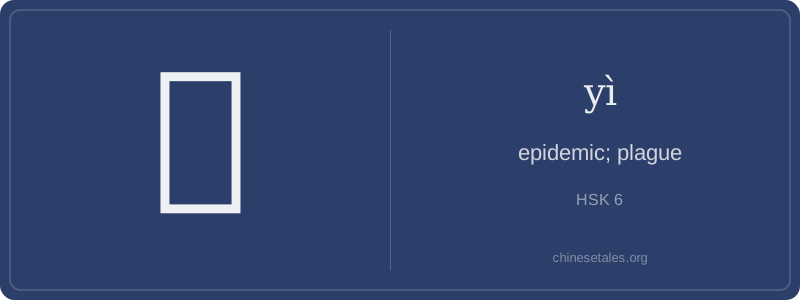
The earliest form of 疫 appears in Warring States bamboo slips (c. 475–221 BCE) as a compound pictograph: the left side was 疒 — a stylized figure lying sick under a roof (the ‘disease’ radical), and the right side was 殹, a variant of 易 (yì), meaning ‘change’ or ‘exchange’. Over centuries, 殹 simplified into 易, retaining the phonetic clue (yì) while reinforcing the idea of rapid, destabilizing change — exactly what a plague does to bodies and societies. By the Han dynasty, the structure stabilized into today’s nine-stroke form: the top-left 疒 (5 strokes) cradling the right-side 易 (4 strokes), visually echoing how disease ‘envelops’ normalcy.
This etymology shaped its semantic journey. In classical texts like the Huangdi Neijing, 疫 described ‘qi-based plagues’ — illnesses spreading through shared air or seasonal imbalance, not germs (unknown then). Confucian commentaries linked epidemics to moral failure or heavenly reprimand — making 疫 a socio-cosmic signal, not just a medical term. Even today, official announcements use 疫情 to frame outbreaks as both biological events and governance challenges, preserving that ancient duality: a word born from sickness + change, now encoding science, policy, and collective memory in nine strokes.
At its core, 疫 (yì) isn’t just ‘epidemic’ — it’s the Chinese language’s visceral shorthand for collective vulnerability: a sudden, invisible threat that disrupts social order, demands state response, and carries moral weight. The character belongs to the 疒 (nè) radical — the ‘sickness’ radical — which appears in all words related to illness (e.g., 病 bìng ‘illness’, 疼 téng ‘pain’). But unlike generic terms like 病, 疫 implies scale, contagion, and societal impact: it’s never used for a stubbed toe or seasonal cold.
Grammatically, 疫 is almost always a noun and rarely stands alone — it thrives in compounds (e.g., 疫情 yìqíng ‘epidemic situation’, 疫苗 yìmiáo ‘vaccine’). You’ll almost never say *‘This is 疫’* — instead, it appears in phrases like 防疫 (fáng yì, ‘epidemic prevention’) or 疫区 (yìqū, ‘epidemic zone’). Learners often mistakenly treat it as an adjective (*‘a 疫 disease’*) or confuse it with verbs — but 疫 itself doesn’t mean ‘to infect’; that’s 传染 (chuánrǎn). It’s a noun with gravitational pull: it draws modifiers, verbs, and policy vocabulary into its orbit.
Culturally, 疫 carries historical gravity — evoking plagues in Sima Qian’s Records or Ming-era smallpox outbreaks — and modern resonance, especially post-2020. A common mistake? Using it without context: saying 疫 alone sounds abrupt, even ominous, like shouting ‘plague!’ at a dinner party. Also, it’s not interchangeable with 流感 (liúgǎn, ‘influenza’) — that’s a specific virus; 疫 is the umbrella crisis category. Think of it as the ‘emergency broadcast system’ of Chinese medical vocabulary: activated only when systems are stressed.