皇
Character Story & Explanation
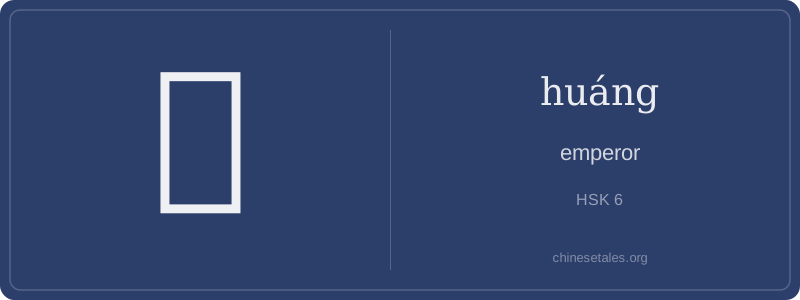
The earliest form of 皇 appears on Shang dynasty oracle bones as a stylized crown atop a head — not a person, but *a radiant headdress*, with three horizontal lines representing light beams or jade pendants, and a vertical stroke symbolizing the upright, centered self. Over centuries, the top evolved into the ‘white’ radical 白 (bái), which originally depicted a rising sun or luminous orb — not ‘white’ as color, but ‘brilliance’. The lower part, 王 (wáng, ‘king’), was added later to reinforce sovereign status, yielding the modern 9-stroke structure: 白 + 王. Notice how the top 白 looks like a glowing halo — no accident.
This visual logic shaped its meaning: 皇 didn’t begin as ‘ruler’ but as ‘radiant one’, ‘august being’ — a term first applied to mythic sage-rulers like Fuxi and Shennong (the 三皇), whose wisdom was said to shine like the sun. By the Qin dynasty, Qin Shi Huang deliberately fused 皇 and 帝 (dì, ‘celestial sovereign’) into 皇帝 to proclaim himself not just king, but *cosmic sovereign* — a title so potent that later dynasties forbade its casual use. Confucius used 皇 in the Analects (16.12) to describe the ideal ruler’s luminous virtue: ‘The people look up to him as to the sky.’ Even today, 皇 retains that celestial shimmer — it’s less about crowns and more about radiance.
Imagine standing in the Hall of Supreme Harmony in Beijing’s Forbidden City — golden roof gleaming, incense curling upward, and a single, massive throne draped in imperial yellow silk. That throne isn’t just furniture; it’s the physical anchor of 皇 (huáng), a word that doesn’t just mean ‘emperor’ but radiates *sacred, cosmic authority*. In classical Chinese, 皇 wasn’t merely a title — it was the human embodiment of Heaven’s mandate, so potent that even uttering it required ritual purity. Today, it survives mostly in formal or literary contexts: you’ll hear it in historical dramas, academic texts, or compound words like 皇帝 (huáng dì), but almost never in casual speech — saying ‘I’m the huáng of this project’ would sound hilariously grandiose, like calling yourself ‘His Majesty of the To-Do List’.
Grammatically, 皇 rarely stands alone as a noun in modern Mandarin — unlike English ‘emperor’, which can function freely. Instead, it almost always appears in compounds: 皇帝 (emperor), 皇后 (empress), 皇室 (imperial family). It can occasionally act as an adjective meaning ‘imperial’ (e.g., 皇恩 — imperial grace), but never as a verb or pronoun. Learners often mistakenly use it where 王 (wáng, ‘king’) or 主 (zhǔ, ‘lord/master’) would be more appropriate — confusing celestial sovereignty with earthly rule or personal authority.
Culturally, 皇 carries a quiet gravity: it evokes not just political power, but cosmological harmony — the emperor stood between Heaven and Earth, his virtue literally holding the universe in balance. This is why 皇 appears in Daoist texts (e.g., 三皇 — Three Sovereigns, mythic culture heroes) and poetic titles (皇天 — ‘August Heaven’), far beyond mere monarchy. A common mistake? Over-translating every ‘emperor’ in English as 皇 — but many Western monarchs are better rendered as 王 or 国王. Reserve 皇 for China’s pre-1912 Son of Heaven — and treat it like sacred text.