皱
Character Story & Explanation
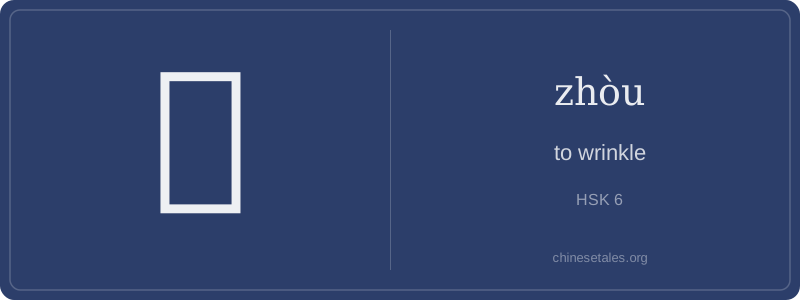
The earliest form of 皱 appears in seal script as a compound: the left side was originally a variant of 畬 (shū), depicting ‘tangled threads’ or ‘distorted lines’, and the right side was 皮 (pí, ‘skin’ or ‘leather’). Over centuries, the left morphed into 爿 (pán, ‘half of something split’), then simplified into the current + 丶 + 一 + 口 shape — but crucially, those four tiny strokes at the top (丶一) mimic jagged, irregular folds — like a leather strap twisted under tension. The bottom 皮 anchors it in the physical world: skin, hide, surface.
This visual logic held firm across dynasties. In the *Shuōwén Jiězì* (121 CE), 皱 is defined as ‘skin that gathers unevenly’, linking it to both anatomy and craftsmanship — tanners knew how leather puckered when dried improperly. By Tang dynasty poetry, it had expanded metaphorically: ‘眉头深皱’ (deeply furrowed brows) signaled moral distress, not just physiology. Its stroke count (10) even echoes its meaning — just enough complexity to suggest disruption, not chaos. The character doesn’t just name wrinkles; it *looks* like one.
Think of 皱 (zhòu) as Chinese for 'crumpling' — not just skin, but paper, fabric, even emotions. It’s the visual equivalent of crumpling a receipt in your fist: sudden, textured, slightly tense. Unlike English ‘wrinkle’, which can be neutral or even desirable (‘wrinkle cream’), 皱 carries subtle negative weight — it implies aging, stress, or disorder. You’ll rarely say ‘a pretty wrinkle’; instead, you 皱眉 (frown), 皱鼻子 (scrunch your nose in disgust), or 皱着脸 (grimace).
Grammatically, 皱 is wonderfully flexible: it works as a verb (他皱了皱眉 — ‘He furrowed his brow’), an adjective (皱巴巴的衬衫 — ‘crumpled shirt’), and even in reduplicated form (皱皱的) for soft texture. Watch out — learners often wrongly treat it as transitive without a clear object (e.g., *‘I wrinkled the shirt’ → wrong word order). In Chinese, it’s usually intransitive or reflexive: 衬衫皱了 (‘The shirt has wrinkled’) or 他把衬衫弄皱了 (‘He messed up the shirt’ — using 弄…了, not 皱了 directly).
Culturally, 皱 is deeply tied to facial expressiveness — a key channel in Chinese communication where words stay restrained but eyebrows speak volumes. Classical poetry uses it sparingly but powerfully: Du Fu wrote of ‘皱纹如壑’ (‘wrinkles like ravines’) to evoke time’s erosion. A common mistake? Confusing 皱 with 折 (zhé, ‘to fold’) — but while 折 is clean and intentional, 皱 is messy and involuntary, like trying to smooth out a napkin after a toddler sat on it.