盗
Character Story & Explanation
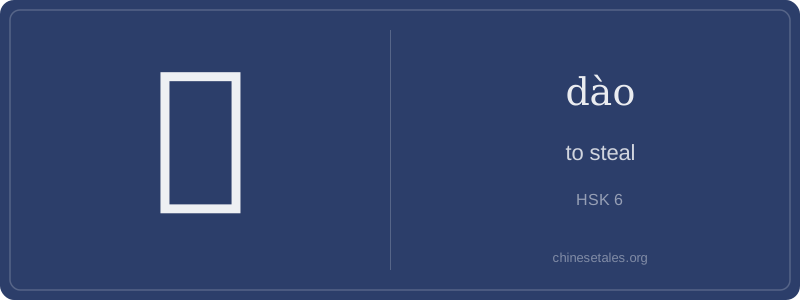
The earliest form of 盗 appears in bronze inscriptions as a pictograph showing a hand (又) reaching into a covered vessel (皿), with a dot or line inside representing the stolen object — imagine a stealthy arm dipping into a ceremonial bronze food basin. Over centuries, the hand simplified into the top-left component (次, cì, here acting phonetically), while the vessel radical 皿 remained intact at the bottom. The middle part evolved from a stylized 'person' or 'foot' into today’s 皿-adjacent strokes — the modern character preserves this ancient scene: an intruder violating a communal container.
This visual logic shaped its meaning deeply: in classical texts like the *Analects*, Confucius contrasts the virtuous person who ‘does not desire what is not his’ with those who ‘covet and steal’ — and 盗 always appears in contexts of moral failure, not mere property crime. By the Han dynasty, it had expanded to include intellectual theft (e.g., plagiarizing poetry), reinforcing the idea that stealing isn’t about objects alone, but about violating boundaries of ownership, authorship, and trust — a concept so ingrained that even today, copyright infringement lawsuits cite the term 盗用 (dào yòng, 'unauthorized use') rather than neutral terms.
At its core, 盗 (dào) isn’t just ‘to steal’ — it carries moral gravity. In Chinese, stealing isn’t merely illegal; it’s a violation of social trust and ritual propriety (lǐ), echoing Confucian ideals where integrity is woven into daily conduct. Unlike English verbs like 'take' or 'borrow', 盗 implies deliberate, unauthorized appropriation with ethical weight — even digital piracy is often called 网络盗版 (wǎngluò dàobǎn), literally 'internet theft', not 'piracy'. You’ll rarely see it used reflexively or casually: you don’t 'steal a glance' (that’s 偷看, tōu kàn); 盗 is reserved for serious, systemic, or formal violations.
Grammatically, 盗 functions primarily as a verb in formal or literary contexts (e.g., 盗取机密 — 'steal classified information'), but also appears in compound nouns like 盗贼 (dào zéi, 'thief') or as the first element in four-character idioms like 盗名窃誉 (dào míng qiè yù, 'steal fame and usurp reputation'). Learners often mistakenly use it where tōu (偷) fits better — 盗 sounds bureaucratic, stern, and slightly archaic; 偷 is colloquial, flexible, and neutral in tone. Saying 我盗了你的笔 (Wǒ dào le nǐ de bǐ) sounds like you’ve breached state security — not misplaced a pen.
Culturally, 盗 reflects how Chinese language encodes moral judgment directly into vocabulary: the character itself contains 皿 (a vessel), suggesting something taken *from* a shared container — a subtle reminder that theft disrupts communal harmony. Also beware: 盗 is never used for metaphorical 'stealing' of attention or time (use 夺, 抢, or 偷); misusing it reveals a foreigner’s literal translation habit — a classic HSK 6 trap.