盯
Character Story & Explanation
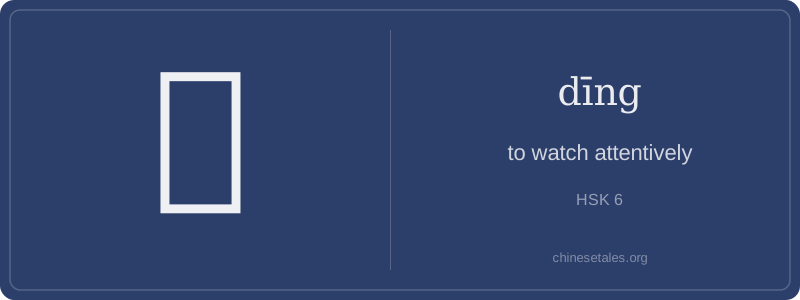
The earliest form of 盯 appears in seal script as a combination of 目 (mù, 'eye') on the left and 丁 (dīng, 'nail' or 'bolt') on the right — not as separate elements, but fused in a way that evokes an eye *piercing* forward like a nail driven straight into its target. The oracle bone precursors didn’t exist for this character (it emerged later, during the Warring States period), but its small, compact shape — just seven strokes — was deliberately engineered for speed and precision: the four horizontal lines of 目 suggest steady, unblinking eyelids; the single vertical stroke of 丁 anchors the gaze like a stake hammered into the ground.
This visual logic became semantic truth: by the Han dynasty, 盯 appeared in texts like the *Shuōwén Jiězì* as 'to fix one’s gaze steadily, as if nailing attention in place.' In classical poetry, it rarely stood alone but anchored phrases like 盯目 (dīngmù, 'fixed gaze') — used in Tang dynasty travelogues to describe monks gazing unwaveringly at mountain peaks during meditation. The 丁 component isn’t phonetic fluff: its pronunciation dīng mimics the sharp, staccato sound of a hammer strike — reinforcing the idea of attention *driven home*, not merely cast outward.
Think of 盯 as the Chinese equivalent of a laser pointer held steady on a target — not just 'looking,' but *locking on* with quiet, unblinking intensity. Unlike generic verbs like 看 (kàn, 'to look') or 观察 (guānchá, 'to observe'), 盯 carries psychological weight: it implies focus so sharp it borders on obsession, suspicion, or anticipation — like a hawk tracking prey or a detective studying a suspect’s micro-expression. It’s almost always followed by a noun or pronoun (e.g., 盯着她, dīng zhe tā), and crucially, it *requires* the aspect particle 着 (zhe) to indicate ongoing action — saying *'dīng tā'* alone sounds jarringly incomplete, like shouting 'stare her!' in English.
Grammatically, 盯 is a transitive verb that rarely stands alone; it thrives in vivid, embodied contexts: 盯屏幕 (dīng píngmù, 'stare at the screen'), 盯梢 (dīng shāo, 'tail someone'), or 盯盘 (dīng pán, 'monitor market fluctuations'). Learners often mistakenly use it for casual glances — but if you’re idly watching clouds, use 看; only reach for 盯 when your eyebrows are furrowed and your breath has slowed. It’s the verb of intent, not curiosity.
Culturally, 盯 can carry subtle tension — in literature or film, a character who 盯s another often signals power imbalance, romantic tension, or impending confrontation. A classic mistake? Confusing it with 瞪 (dèng, 'to glare'), which conveys anger, not focus. Also, avoid overusing it in formal writing: while common in dialogue and descriptive prose, it’s rarely found in academic or bureaucratic texts — where 观察 or 注视 (zhùshì) reign instead.