睬
Character Story & Explanation
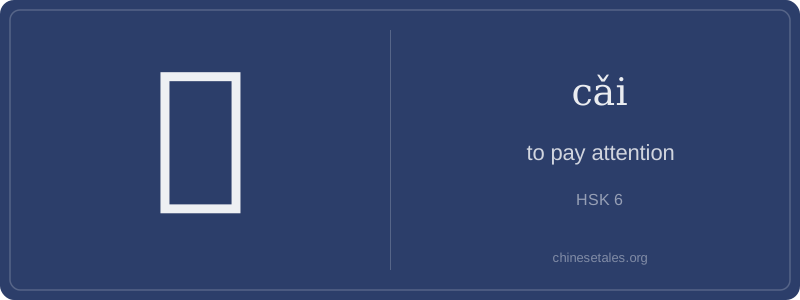
The earliest forms of 睬 don’t appear independently in oracle bone script — it’s a later character, emerging during the Warring States period as a semantic-phonetic compound. Its left side, 目 (mù), is unmistakably the ‘eye’ radical — stylized since Shang times as a rectangular eye with a pupil dot. The right side, 采 (cǎi), originally depicted a hand picking fruit from a tree (爪 + 木), symbolizing ‘to gather’ or ‘to select’. When combined, the visual logic is elegant: ‘to select with the eyes’ — i.e., to choose *whom* to look at, acknowledge, or engage with. Over centuries, the 采 component simplified, losing its claw-like top and becoming the modern 采 shape we see today — 8 strokes total on the right, anchored by the vigilant 目 (5 strokes) on the left.
This ‘selective looking’ meaning solidified early in classical usage. In the Han dynasty text Shuō Yuàn (Garden of Stories), we find phrases like ‘不以目睬之’ (not deigning to cast one’s eyes upon him), underscoring its connotation of dignified, conscious choice. By Tang poetry, 睬 had become idiomatic in expressions like ‘青眼相睬’ (looking with the black (friendly) eye — i.e., favorably), directly referencing the physiological contrast between the white sclera (dismissive) and dark iris (attentive). The character thus encodes ancient Chinese somatic philosophy: attention isn’t passive reception — it’s an embodied, ethical act.
At its heart, 睬 (cǎi) isn’t just ‘to pay attention’ — it’s the deliberate, often socially charged *act of granting notice*. Think of it as the linguistic equivalent of making eye contact and nodding: intentional, selective, and sometimes loaded with attitude. Unlike generic verbs like 注意 (zhùyì), 睬 carries a subtle emotional valence — you might 睬 someone warmly, dismissively, or not at all. It’s almost always used in negative or contrastive constructions: 没人理睬 (no one pays attention), 谁也不睬他 (nobody deigns to acknowledge him).
Grammatically, 睬 is nearly always paired with 理 (lǐ) as the compound 理睬 — they function as a single inseparable verb meaning ‘to take notice of’. You’ll almost never see 睬 alone in modern usage; even in classical texts, it appears as part of fixed collocations. Learners often mistakenly try to use it transitively like ‘I cǎi you’, but it resists that — it’s inherently relational and contextual. The subject must be someone capable of social recognition (a person, group, or institution), and the object is typically someone seeking validation.
Culturally, 睬 reflects deep Chinese values around face (miànzi), hierarchy, and reciprocity. To refuse to 睬 someone isn’t merely ignoring them — it’s a quiet social sanction, a withdrawal of acknowledgment that can sting more than an insult. That’s why phrases like ‘连正眼都不睬’ (not even glance at with proper eyes) carry such sharp disdain. A common learner pitfall? Confusing it with similar-sounding characters like 彩 or 采 — but those have zero connection to perception or attention. Remember: 目 (eye) radical = this word is about *seeing* someone *as worthy of your gaze*.