睹
Character Story & Explanation
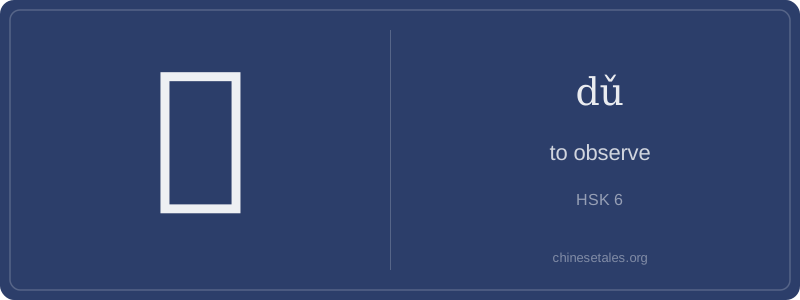
The earliest form of 睹 appears in bronze inscriptions as a combination of 目 (eye, drawn as a stylized eye with eyelid and pupil) and 者 (zhě, originally a phonetic component meaning ‘one who…’, but pictographically depicting a hearth with firewood — later simplified). In seal script, the 目 radical dominates the left, while the right side evolved from 者’s complex structure into today’s simplified 者 — retaining its phonetic role (dǔ and zhě share ancient rhyme group ties). The 13 strokes crystallize this duality: 5 for 目 (the eye observing), 8 for 者 (the person who observes — grounded, intentional).
By the Warring States period, 睹 had shifted from neutral ‘to see’ to ‘to witness with significance’. Mencius (孟子) uses it in ‘目不见睫,而能见远’ — implying that true 睹 requires self-awareness first. Later, Tang poets like Du Fu employed 睹 to heighten emotional gravity: ‘感时花溅泪,恨别鸟惊心’ subtly relies on the implied 睹 — the observer isn’t passive; they’re morally implicated by what they witness. Visually, the character’s balance — eye on left, grounded ‘person’ on right — mirrors its semantic core: perception anchored in presence and consequence.
Think of 睹 (dǔ) as Chinese’s ‘courtroom gaze’ — not just casual looking, but deliberate, focused observation with moral or evidentiary weight, like a judge scrutinizing testimony. Unlike English ‘see’ or even ‘look’, 睹 implies witnessing something significant, often unexpected or consequential: you don’t ‘dǔ’ your morning coffee, but you might ‘dǔ’ a historic handshake or a sudden betrayal. It’s literary and formal — rare in speech, frequent in essays, news, and classical allusions.
Grammatically, 睹 is almost always transitive and appears in compound verbs (e.g., 目睹, 耳闻目睹) or set phrases — it rarely stands alone. You’ll almost never say ‘我睹了’; instead, it’s ‘亲眼目睹’ (witnessed with one’s own eyes) or ‘初睹芳容’ (first glimpse of someone’s beauty, used with elegant irony). Learners often mistakenly use it like 看 or 见 — but 睹 carries gravity: swapping it in for 看 turns ‘I saw the dog’ into ‘I solemnly witnessed the canine event’.
Culturally, 睹 evokes Confucian ideals of clear-sighted moral discernment — to ‘dǔ’ is to see *truly*, not just visually. A common mistake? Overusing it in spoken contexts or misplacing it in passive constructions. Also, watch tone: dǔ (third tone) sounds identical to 杜 (to block) and 渡 (to ferry), so mispronunciation can accidentally turn ‘I witnessed’ into ‘I blocked’ or ‘I ferried’ — an absurd but memorable blunder.