瞄
Character Story & Explanation
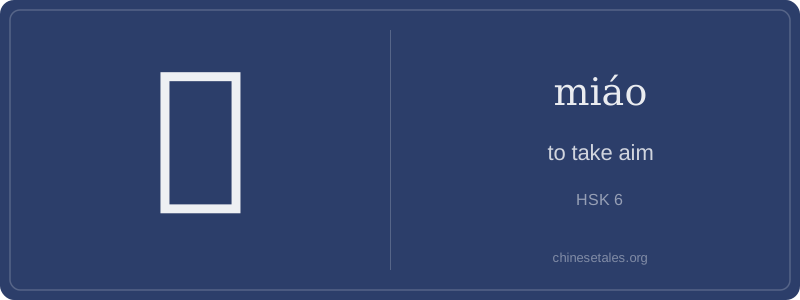
The earliest form of 瞄 doesn’t appear in oracle bones — it’s a later invention, emerging around the Warring States period as firearms and crossbows gained tactical importance. Visually, it’s a brilliant fusion: the left side 目 (mù, 'eye') anchors it in vision, while the right side 苗 (miáo, 'young plant, sprout') was borrowed purely for its sound — a classic phonetic-semantic compound (形声字). But here’s the clever twist: 苗 itself depicts a sprout breaking through soil, evoking *emergence* and *directional growth* — mirroring how the eye ‘grows’ toward a target, focusing its line of sight like a stem reaching sunward.
By the Tang dynasty, 瞄 appears in military manuals describing archery technique — not just sighting, but *sighting with controlled breath and stabilized posture*. In classical poetry, it occasionally appears metaphorically: Li Bai used a variant form to describe stars 'aiming' their light down on earth, personifying celestial precision. The modern shape crystallized in the Song dynasty standardization: 13 strokes total — five for 目 (the 'eye' radical), eight for 苗 (grass + field), visually echoing the idea of an eye *rooted* in attention and *growing* toward its mark.
Think of 瞄 (miáo) not as 'to aim' in the dry, mechanical sense — but as the *intimate, focused act* of aligning eye, intention, and target in one breath. It’s what a sniper does before pulling the trigger, yes — but also what a poet does when choosing the perfect word, or a student does when locking eyes with a complex grammar point. The character radiates precision and quiet intensity: you’re not just looking; you’re calibrating vision to purpose.
Grammatically, 瞄 is almost always transitive and often appears in compound verbs like 瞄准 (miáo zhǔn, 'to aim at') or as part of serial verb constructions: 他举起枪,瞄了一眼远处的靶子 (Tā jǔ qǐ qiāng, miáo le yī yǎn yuǎn chù de bǎ zi — 'He raised the gun and took a quick look at the distant target'). Note the aspect particle 了 and measure word 眼 — learners often omit them, saying *miáo le bǎ zi*, which sounds unnatural. Also, 瞄 rarely stands alone; it’s nearly always paired with a directional or result complement (e.g., 瞄准, 瞄向, 瞄着).
Culturally, 瞄 carries subtle connotations of stealth and deliberation — it’s not casual glancing (看), nor admiring gazing (瞧), nor suspicious staring (盯). It implies intent concealed behind stillness. A common mistake? Using 瞄 where 看 or 观察 would be more neutral — e.g., saying 我瞄了眼报告 when you mean 'I glanced at the report' (too sharp, too tactical!). Reserve 瞄 for moments when the eye becomes a tool of strategy.