瞪
Character Story & Explanation
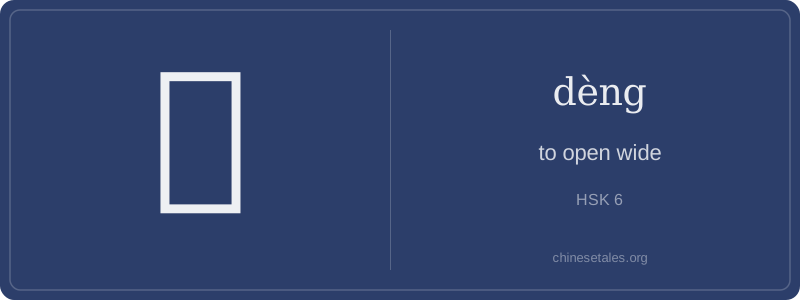
The earliest form of 瞪 doesn’t appear in oracle bones—but its key component 登 does: a pictograph of feet climbing a ladder-like platform (⿱癶豆), symbolizing ascent. When combined with 目 around the late Warring States period, the visual logic clicked: eyes *rising up*, stretching open—not just open, but *lifted* in sudden exertion. The modern shape preserves that climb: the top two strokes of 登 resemble ascending steps, and the lower part (豆) evolved into the curving base beneath the eye radical—like eyes straining upward against gravity.
This ‘upward-opening’ idea deepened over time: in Tang poetry, 瞪 described awe-struck gazing at mountains (‘瞪目仰天’); by Ming-Qing vernacular fiction, it had hardened into its modern sense of sharp, confrontational staring. Crucially, it never meant ‘to look carefully’ (that’s 瞧 or 察)—its essence is physiological intensity: widened pupils, tightened brows, unblinking focus born of emotion, not intention. Even today, when a teacher 瞪s a noisy student, it’s less about seeing and more about *making felt*.
At its core, 瞪 isn’t just ‘to open wide’—it’s the visceral, involuntary flaring of the eyes in shock, anger, disbelief, or intense scrutiny. Think of a startled owl, a scolding parent, or someone caught red-handed: this character carries weight, tension, and often confrontation. The radical 目 (eye) anchors it visually and semantically, while the right side 登 (dēng, ‘to ascend’) hints at upward movement—like eyes literally lifting wide open. It’s not neutral; you don’t 瞪 happily—you 瞪 *at* someone or *in* reaction.
Grammatically, 瞪 is almost always transitive and action-oriented: it takes an object (e.g., 瞪他, 瞪着地板) and frequently appears in compound verbs like 瞪眼 (dèng yǎn, ‘to glare’) or as part of vivid descriptive phrases. Learners mistakenly use it for gentle widening (that’s 张 or 张开); 瞪 implies intensity and agency—it’s never passive. Also, it rarely stands alone as a main verb in formal writing; you’ll see it embedded in dialogue tags (‘he said, 瞪着我’) or narrative description (‘她猛地一瞪,吓得他后退半步’).
Culturally, 瞪 is a high-stakes facial cue—too much can signal aggression or loss of composure, especially in hierarchical contexts. In classical texts, it appears in martial or emotional climaxes (e.g.,《水浒传》describing Lin Chong’s furious gaze before rebellion). Modern usage leans colloquial but retains dramatic force: in film subtitles, novels, or heated arguments, 瞪 is the quiet explosion before words fly.