瞩
Character Story & Explanation
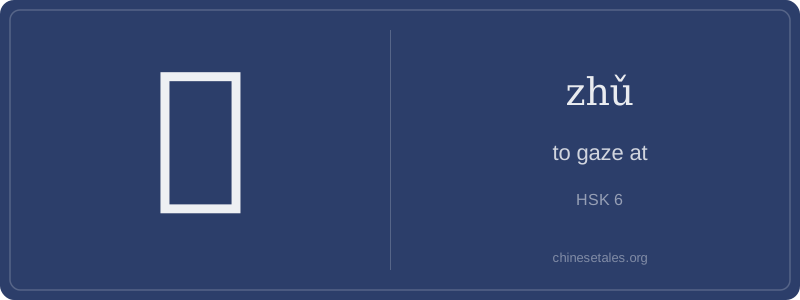
The earliest form of 瞩 appears in seal script (c. 3rd century BCE), built from 目 (mù, 'eye') on the left — clearly depicting an eye with pupil — and 属 (shǔ, 'to belong to, to be under jurisdiction') on the right. 属 itself evolved from a hand holding a rope tied to a group of people — symbolizing control, assignment, or close connection. So visually, 瞩 fused 'eye' + 'under direct jurisdiction' → 'eyes fixed *on what matters*, what one is entrusted to observe'. Over time, the right side simplified from the full 属 (12 strokes) to its modern 10-stroke form, while the 目 radical retained its clear, boxy eye shape — making this a classic semantic-phonetic compound where 属 also hints at pronunciation (shǔ → zhǔ via sound shift).
This visual logic shaped its meaning: in classical texts like the *Zuo Zhuan*, 瞩 appears rarely but powerfully — always describing a ruler or sage directing their gaze toward critical matters: a border crisis, a celestial omen, or a loyal minister’s conduct. It wasn’t about curiosity, but stewardship of vision. By the Tang dynasty, poets used 瞩望 to express yearning for distant homelands or ideals — transforming 'jurisdictional gaze' into 'heart-led attention'. Today, that layered history lives on: every time you read 万众瞩目, you’re echoing a 2,500-year-old idea — that where we fix our eyes reveals what we hold accountable.
At its heart, 瞩 (zhǔ) isn’t just ‘to gaze’ — it’s to gaze with weight: focused, deliberate, often reverent or awestruck. Think of a crowd holding its breath as a leader steps onto the stage, or scholars leaning in to study an ancient scroll. This isn’t casual looking; it’s *attentive witnessing*. In modern usage, 瞩 almost never stands alone — it only appears in compounds like 举世瞩目 (jǔ shì zhǔ mù, 'attracting worldwide attention') or 众目睽睽 (zhòng mù kuí kuí, though here it's the related 睽, not 瞩 — a common trap!). You’ll never say 'I 瞩 at the mountain'; instead, you say 'the mountain is 举世瞩目' — it’s inherently passive or compound-bound, reflecting a cultural tendency to frame significance not through individual action but through collective perception.
Grammatically, 瞩 is strictly literary and formal — absent from daily speech and HSK 1–5 materials. It thrives in news headlines, political speeches, and academic writing, always paired: 瞩目 (zhǔ mù, 'to attract attention'), 瞩望 (zhǔ wàng, 'to look forward to with expectation'). Learners often misapply it as a verb like 看 or 观看, leading to jarring, unnatural sentences. Another pitfall: confusing its tone — zhǔ (third tone, falling-rising), not zhū or zhù — which changes everything (e.g., 猪 vs. 助).
Culturally, 瞩 reveals how Chinese values link vision with moral responsibility: to 'gaze upon' something notable is to implicitly acknowledge its importance — and by extension, your duty to respond. That’s why 举世瞩目 carries gravity beyond 'worldwide attention'; it implies historical consequence. Native speakers feel its weight — which is why using it casually sounds pompous or ironic, like saying 'behold!' in English when checking your phone.