砸
Character Story & Explanation
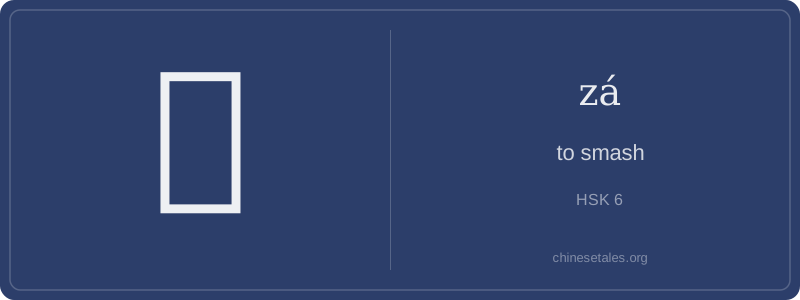
The earliest form of 砸 isn’t in oracle bones (it’s too late for that), but its components tell an ancient tale: the left side 石 (shí, 'stone') was already a pictograph of a rocky outcrop — solid, unyielding, heavy. The right side 则 (zé) originally depicted a 'knife' (刂) beside 'spoon/bowl' (贝), evolving to mean 'rule' or 'standard' — but in 砸, it’s purely phonetic. Crucially, by the Han dynasty, scribes began writing 则 with a 'downward stroke' emphasis, subtly reinforcing the vertical force implied by the action. Over centuries, the stone radical anchored the meaning in physical weight, while the right-hand component stabilized the pronunciation — and the whole character settled into its modern 10-stroke shape, looking like a stone dropping straight down onto a target.
This visual logic cemented its meaning: not just 'break', but *impact-driven* destruction. In Ming dynasty vernacular fiction like Water Margin, 砸 appears in fight scenes — 'he grabbed the stool and zá-ed it onto the bandit’s head'. By the Qing era, it had entered everyday speech with a punchy, informal tone, and today it still thrums with that same raw, tactile urgency — a character born from gravity, grit, and the satisfying crunch of something giving way.
Think of 砸 (zá) as the Chinese equivalent of a cartoon 'THWACK!' — it’s not just 'to break'; it’s the visceral, noisy, often reckless act of bringing something heavy down *onto* something else with force: a hammer on glass, a rock on a phone, a fist on a table. Unlike the neutral 'break' (打破 dǎ pò), 砸 implies agency, impact, and usually destruction — and it almost always involves downward motion, like gravity joining the assault.
Grammatically, 砸 is wonderfully flexible: it can be transitive ('He smashed the vase'), intransitive ('The vase smashed'), or even causative in colloquial speech ('Don’t smash your hopes!'). It also appears in vivid idioms like 砸锅卖铁 (zá guō mài tiě — 'smash the wok and sell the iron', meaning to go all-in, no matter the cost). Learners often mistakenly use it for gentle breaking (e.g., 'the cup broke' → better: 杯子碎了 bēi zi suì le), or confuse it with passive verbs — but 砸 is always *active*, intentional, and physical.
Culturally, 砸 carries a gritty, working-class energy — you’ll hear it in factory slang, street banter, and political satire (e.g., 砸烂旧世界 zá làn jiù shì jiè — 'smash the old world'). A classic pitfall? Using it for abstract 'breaking' like 'break a promise' (that’s 违背 wéi bèi) — doing so makes you sound like you’re threatening to hurl a boulder at someone’s vow.