碑
Character Story & Explanation
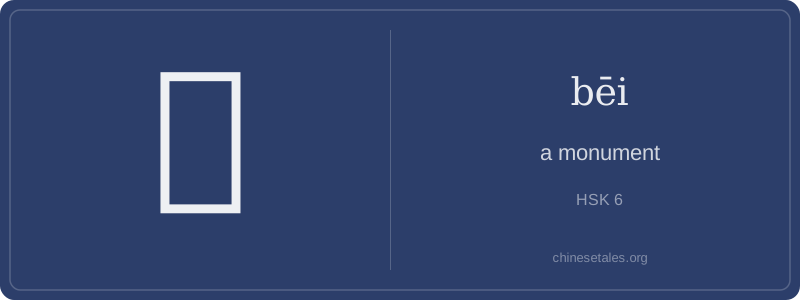
The earliest form of 碑 appears in Han dynasty steles — not oracle bones, but carved stone itself! The character evolved from a simple pictograph: a vertical line (丨) representing the upright stone slab, flanked by two short horizontal strokes (一) suggesting chisel marks or inscribed lines, all resting on the radical 石. Over centuries, the top simplified into 卑 — originally a separate character meaning 'lowly' or 'base', visually depicting a person (the 'hand' component later abstracted) kneeling beneath a roof, signifying humility or foundation. When fused with 石, it created a compound that meant 'stone set low in the earth' — exactly how ancient boundary and funeral markers were placed.
By the Eastern Han, 碑 had transformed from humble grave marker to revered cultural artifact. The famous Yi Ying Stele (乙瑛碑) and Liang Fu Stele (礼器碑) weren’t just memorials — they were canonical models of clerical script, studied for centuries. Poets like Du Fu referenced 碑 to evoke lost glory ('broken steles under autumn grass'), while historians used them as primary sources. Crucially, the visual weight of 碑 — thirteen deliberate strokes, balanced yet grounded — mirrors its function: to stand immovable, bearing truth across dynasties. Its shape *is* its promise: stone + inscription = permanence.
Think of 碑 (bēi) as China’s stone storyteller — not just a slab of rock, but a carved chronicle. Its radical 石 (shí, 'stone') anchors it firmly in the material world: monuments are literally made of stone. The right side 卑 (bēi) is both phonetic (giving the sound) and subtly semantic — in ancient usage, 卑 carried connotations of 'low position' or 'humble base', reflecting how early stelae were originally *buried upright* in the ground as boundary markers or funerary anchors before evolving into towering, inscribed memorials. So 碑 isn’t passive decor; it’s stone with intention, gravity, and voice.
Grammatically, 碑 is a countable noun used with measure words like 座 (zuò) or 通 (tōng) — you don’t say *yī gè bēi*, but *yī zuò bēi* (a monument). It appears in formal, historical, or literary contexts: you’ll see it in museum labels (石碑), poetry (墓碑), or political discourse (纪念碑), but rarely in casual speech. Learners often overgeneralize it to mean any 'sign' or 'plaque' — but that’s usually 牌 (pái); confusing them is like calling the Liberty Bell a 'business card'.
Culturally, 碑 is deeply tied to memory-making and authority: imperial edicts, Confucian teachings, and even modern national narratives are legitimized by being carved onto stone. There’s also a fascinating twist — in calligraphy, 'stele style' (碑学, bēi xué) refers to bold, angular brushwork inspired by ancient inscriptions, making 碑 not just an object but an aesthetic ideal. Mistake it for a mere 'statue' (雕像, diāoxiàng), and you miss its textual soul: a 碑 must bear writing to be truly a 碑.