禽
Character Story & Explanation
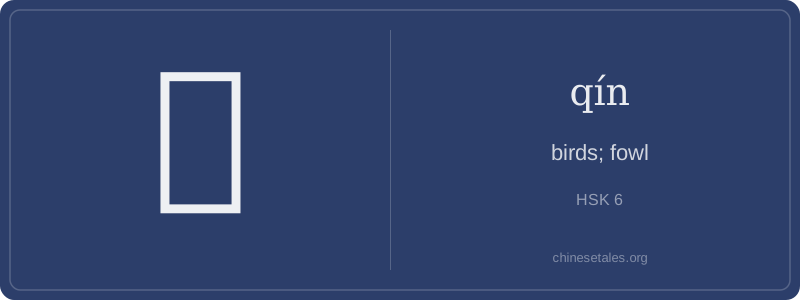
The earliest form of 禽 appears in Shang dynasty oracle bones as a vivid pictograph: a bird (the top part, resembling today’s 今 + 人) perched atop the character for ‘to hunt’ or ‘to capture’ — originally drawn with legs chasing prey, later stylized into the radical 禸 (rǒu), which depicts animal tracks. Over centuries, the upper element simplified from a full bird silhouette to 今 (jīn) — not meaning 'now', but a phonetic component borrowed for sound — while the lower part evolved from hunting feet into 禸, preserving the idea of pursuit and capture.
This visual logic carried into meaning: 禽 never meant 'any bird flying free'; it meant 'bird taken — whether hunted, tamed, or offered'. The Shijing (Book of Odes) uses it in verses about royal hunts: '射禽兽' (shè qín shòu, 'shoot birds and beasts') — placing 禽 alongside wild animals, not pets. By the Han dynasty, it had broadened to include domesticated fowl, cementing its role in the 'three livestock' triad: 畜 (xù, livestock), 禽 (qín, fowl), and 鱼 (yú, fish). Even today, its shape whispers: 'What’s above is sky — what’s below leaves tracks — and together, they mean 'captured sky-creature'.
Think of 禽 (qín) not as just 'bird' but as the ancient Chinese word for 'feathered game' — birds caught or raised for food, ritual, or tribute. It’s a formal, literary term, rarely used in daily speech (you’d say 鸟 niǎo for 'bird' or 鸡 jī for 'chicken'). In classical and modern written Chinese, 禽 carries a sense of dignity and taxonomy: it appears in compound terms like 家禽 (jiā qín, 'poultry') and 野禽 (yě qín, 'wildfowl'), always implying classification, utility, or ecological category — never casual observation.
Grammatically, 禽 is almost never standalone; it’s a bound morpheme. You won’t say *‘This is a qín’ — you’ll say 家禽很多 (jiā qín hěn duō, 'There is much poultry') or 禽流感 (qín liú gǎn, 'avian flu'). Note: it’s always pluralized implicitly — no measure words needed when used generically (e.g., 禽类, qín lèi, 'birds/fowl as a class'). Learners often mistakenly use it like 鸟 and get odd results: saying 我看见一只禽 sounds like 'I saw a piece of poultry' — hilariously dehumanizing!
Culturally, 禽 reflects China’s agrarian cosmology: birds were omens (think phoenix), sacrificial offerings (《诗经》 mentions 禽 in ritual hunts), and symbols of heaven’s reach. Its radical 禸 (rǒu) — rare and archaic — originally meant 'tracks of a beast', hinting that 禽 was conceived as 'game tracked and captured'. Modern learners miss this nuance and default to 鸟, missing the layered respect embedded in 禽: it’s not just feathered life — it’s life integrated into human order.