秃
Character Story & Explanation
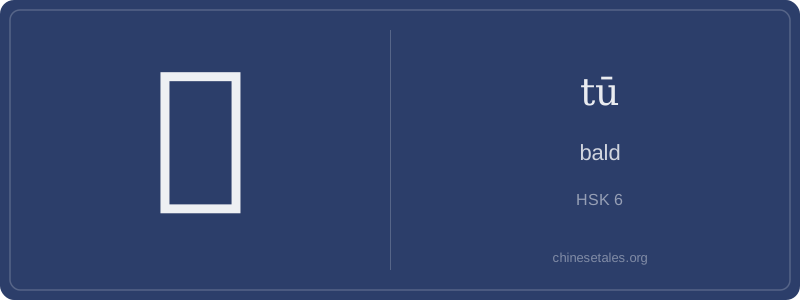
The earliest form of 秃 appears in bronze inscriptions as a stylized head with no hair — but here’s the surprise: the top wasn’t originally 'hairless scalp'; it was a simplified depiction of a *head with a ritual headdress removed*, shown by a bare 'top' component (a precursor to 人 + 一) above the radical 禾. Over time, the upper part evolved into the modern 亠 + 冖 + 几 shape — representing a clean, smooth, exposed surface — while the lower 禾 (originally unrelated to grain) was retained as a phonetic-semantic anchor from Old Chinese *tʰuk, where '禾' approximated the sound and subtly reinforced 'bareness' (like harvested fields stripped of stalks).
This visual logic deepened in meaning: by the Han dynasty, 秃 appears in texts like the Shuōwén Jiězì explicitly defined as 'lacking hair on the head', but already extended metaphorically — '秃岭' (barren ridges), '秃笔' (a worn-out brush tip). The character’s austerity — just seven strokes, no frills — mirrors its semantic economy: one sharp visual, one precise meaning, zero ambiguity. Even today, its silhouette evokes smoothness, exposure, and quiet finality — like a stone smoothed by centuries of wind.
Think of 秃 (tū) as Chinese’s version of the phrase 'bald as a cue ball' — but with a twist: it’s not just about hair loss. In Chinese, 秃 carries a subtle, almost poetic bluntness. It’s not clinical (like 脱发 tuōfà, 'hair loss') nor humorous (like 光头 guāngtóu, 'shaved head'); it’s the quiet, unadorned descriptor for *natural* baldness — often implying age, inevitability, or even dignity. You’ll see it in literature describing elders’ foreheads or in metaphors like 秃山 ('bald mountain'), meaning barren, treeless terrain — a usage that feels surprisingly Shakespearean in its stark imagery.
Grammatically, 秃 is almost always an adjective, but unlike English ‘bald’, it rarely stands alone. It needs a noun: 秃顶 (tū dǐng, 'bald crown'), 秃头 (tū tóu, 'bald head'), or compounds like 秃鹫 (tū jiù, 'vulture' — literally 'bald eagle'). Crucially, you *cannot* say '他秃' as a full sentence — it sounds incomplete or jarring; instead, say '他秃了' (tā tū le, 'He’s gone bald') or '他是个秃子' (tā shì gè tūzi, 'He’s a bald man'). Learners often overuse it as a verb or forget the aspect particle — a classic HSK 6 trap.
Culturally, 秃 isn’t inherently negative — unlike English where 'bald' can carry jokes or insecurity, Chinese texts sometimes treat 秃 as stoic or venerable (e.g., classical monks described with 秃顶 without irony). But beware: 秃子 (tūzi) is colloquial and *can* be mildly pejorative depending on tone and context — best reserved for informal speech or self-reference. Also, never confuse it with 禾 (hé, 'grain') — yes, 秃 shares that radical, but the connection is ancient and agricultural, not botanical!