秤
Character Story & Explanation
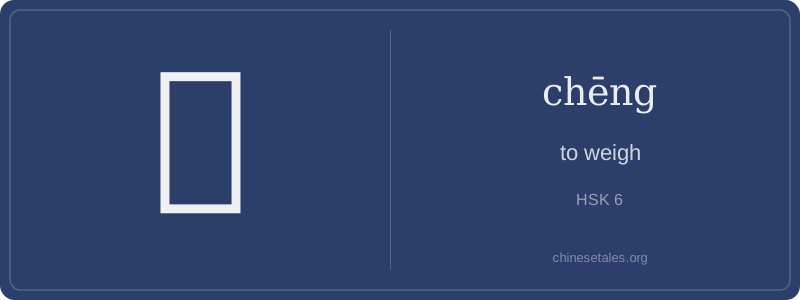
The earliest form of 秤 appears not in oracle bones but in Han dynasty bronze inscriptions and seal script, where it clearly combines two elements: 禾 (hé, ‘grain’, ‘cereal’) on the left and 平 (píng, ‘level’, ‘even’) on the right — though 平 was later stylized into 评’s right side (in modern 秤, the right component is actually 评 without 言, evolving into the simplified form we see today). The original idea was brilliant: grain — the most fundamental commodity — weighed on a level, balanced device. The ‘grain’ radical wasn’t arbitrary; in ancient China, grain defined value, tax, and survival — so the scale wasn’t for jewels or silk first, but for rice and millet. Over centuries, strokes streamlined: the top horizontal of 平 merged, the dots simplified, and by the Kangxi dictionary era, 秤 had settled into its current 10-stroke structure.
This grain-and-balance logic echoes across classical texts. In the *Book of Rites* (Lǐjì), fair measurement is tied to virtue: ‘The ruler must have a true scale in his heart.’ By Tang poetry, 秤 appears metaphorically — Li Bai wrote of ‘a heart lighter than a feather, yet heavier than a scale’ — playing on its dual weightiness and precision. Visually, the character still whispers its origin: 禾 reminds us that weighing began not in labs, but in granaries, where trust was measured in bushels — and betrayal, in a single extra grain.
At its heart, 秤 (chēng) isn’t just a neutral verb meaning ‘to weigh’ — it carries the quiet authority of fairness, precision, and accountability. In Chinese thought, weighing isn’t merely mechanical; it’s moral. The character evokes the ancient marketplace scale — not digital readouts, but a balanced beam with hanging pans and sliding weights, where honesty was literally measured in grams. That’s why 秤 often appears in metaphors about justice (e.g., 心中有一杆秤 — ‘one has a scale in one’s heart’) or social equity.
Grammatically, 秤 is primarily a verb (chēng), used transitively: you 称 (chēng) something *on* a scale — but note the spelling quirk! While the character is written 秤, the verb form is almost always written as 称 (same pronunciation chēng, different character). Yes — this trips up even advanced learners! You write 称重 (chēng zhòng, ‘to weigh [something]’), not 秤重. The character 秤 itself is overwhelmingly nominal: it refers to the *scale* or *balance* as an object. So you buy a 秤, calibrate a 秤, or see a vendor using a 秤 — but you *do* the action of weighing with 称.
Culturally, the confusion between 秤 and 称 is the #1 learner pitfall — and it’s deeply revealing. It mirrors how Chinese orthography separates *tool* (秤, the physical instrument) from *action* (称, the verb), much like ‘key’ vs. ‘to key in’. Also, don’t miss the alternate reading chèng — used only in fixed terms like 秤砣 (chèng tuó, ‘counterweight’), where the tone shift signals a noun-specific, classical register. Pronouncing 秤 as chèng outside those compounds sounds archaic or dialectal — a subtle reminder that tone isn’t just musical; it’s semantic scaffolding.