妻
Character Story & Explanation
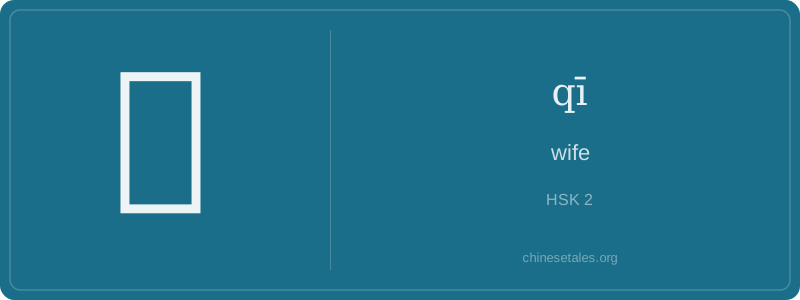
The earliest form of 妻 appears in oracle bone inscriptions as a pictograph showing a woman (女) with hair tied up and a hand (又) gently grasping her head—a stylized depiction of a bride having her hair bound in ceremony, symbolizing her transition into marriage. Over centuries, the ‘hand’ evolved into the top-left component (⿱一), while the ‘woman’ radical (女) settled firmly at the bottom. By the seal script era, the structure solidified: two horizontal strokes above a bent line (representing the binding gesture), then the full 女 radical—totaling eight clean, balanced strokes.
This visual origin reflects its core meaning: not just ‘female spouse’, but ‘ritually affirmed wife’. In the Book of Rites, 妻 is explicitly distinguished from concubines (qiè) and servants—only 妻 could perform ancestral rites. Interestingly, classical texts like the Analects use 妻 neutrally, without hierarchy: Confucius refers to his own wife simply as ‘qī’, underscoring her role as moral and domestic anchor. The character’s enduring shape—elegant yet grounded—mirrors how Chinese tradition honors marital partnership as both solemn and stabilizing.
Imagine a quiet courtyard in ancient Luoyang: a man bows deeply to a woman holding a broom—not as servant, but as equal partner. This isn’t a servant or concubine; it’s his qī—his formally married wife, the cornerstone of family continuity and social legitimacy. In modern Chinese, 妻 carries quiet dignity: it’s formal, respectful, and slightly literary—not used in casual chat like ‘lǎo pó’ (old woman, slang for wife). You’ll see it in official documents, news reports, or when speaking respectfully: ‘tā de qī shì yī shēng’ (his wife is a doctor).
Grammatically, 妻 rarely stands alone—it almost always appears in compounds (like fū qī) or with possessive pronouns (wǒ qī, tā qī). Crucially, it’s *not* used with ‘de’: you say ‘wǒ qī’, not ‘wǒ de qī’—a subtle but frequent learner error. Also, unlike English ‘wife’, 妻 implies legal, ritual, and often ancestral recognition—not just cohabitation.
Culturally, 妻 anchors the Confucian ‘fū qī yǒu bié’ (husband and wife have distinct roles)—but never subservience. Learners sometimes overuse it thinking it’s neutral, when ‘lǎo pó’ or ‘ài rén’ fits better in daily talk. And watch that tone: qì (with fourth tone) appears only in archaic poetry or fixed phrases like ‘qì zǐ’ (to abandon one’s wife), but for HSK 2, stick to qī—always first tone.