始
Character Story & Explanation
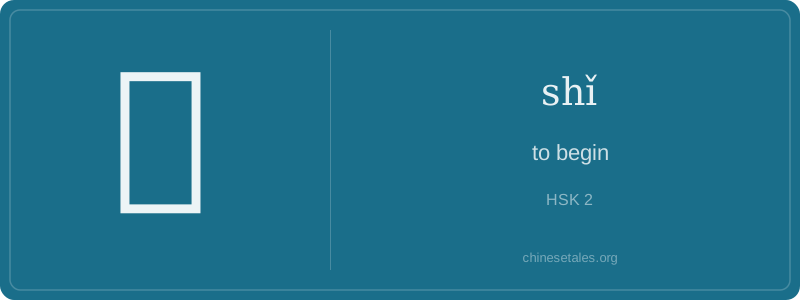
The earliest form of 始 appears in bronze inscriptions around 1000 BCE — not as a woman, but as a stylized ‘woman’ (女) radical paired with 台 (tái), a phonetic component that originally depicted a raised platform or altar. In oracle bone script, 台 looked like a stepped mound — symbolizing elevation, importance, and ritual inauguration. Over centuries, 台 simplified into 台 (still seen in modern 始), while the ‘woman’ radical remained prominent, perhaps reflecting ancient associations between women and life’s beginnings (birth, weaving, nurturing). By the Qin dynasty, the character had stabilized into its current eight-stroke structure: three strokes for 女 (a bent figure with arms and skirt), then five for 台 (丨、丿、口、厶, with the final dot).
This visual pairing — woman + sacred platform — suggests an origin tied to ritual initiation: the moment a rite, reign, or lineage is formally declared. In the Classic of Poetry, 始 appears in lines like ‘王事靡盬,不能艺稷黍;父母何怙?悠悠苍天,曷其有所?’ — where 始 subtly underpins themes of duty’s origin. Later, in Han dynasty commentaries, 始 became philosophically charged: Zhu Xi wrote that ‘知始而后能成’ (To know the beginning is to achieve completion) — cementing its role as both temporal marker and ethical cornerstone.
Think of 始 (shǐ) as the Chinese equivalent of the Latin prefix 'in-' in 'initiate' or 'origin' — it’s the quiet, authoritative spark before anything else happens. Unlike English ‘begin’, which is a verb you conjugate (I begin, she began), 始 is rarely used alone in modern spoken Mandarin; instead, it’s the dignified, slightly formal root inside compound words like 开始 (kāishǐ, 'to start') or 始终 (shǐzhōng, 'from beginning to end'). It carries gravitas — you’d say 会议开始了 (The meeting has begun), not *我始了 — it doesn’t take personal subjects or tense endings like regular verbs.
Grammatically, 始 almost never stands solo in speech (unlike HSK 1 verbs like 吃 or 去). Its power lies in compounds and fixed expressions: it’s the ‘first note’ in a musical phrase, not the whole melody. Learners often mistakenly try to use it as a standalone verb — a classic ‘HSK 2 trap’. Also, while it means ‘to begin’, it’s never used for physical movement (e.g., ‘start walking’ → 走, not 始); it marks abstract or event-based initiation — meetings, projects, eras, or intentions.
Culturally, 始 echoes Confucian reverence for origins: the first step defines the path (始为本 — ‘the beginning is the foundation’). In classical texts like the Doctrine of the Mean, 始 appears alongside 终 (end) to frame moral cultivation as a complete arc. Modern learners also mix it up with 已 (yǐ, ‘already’) — writing 始 when they mean ‘already started’, causing a hilarious time paradox: ‘I began… but haven’t begun yet!’