谷
Character Story & Explanation
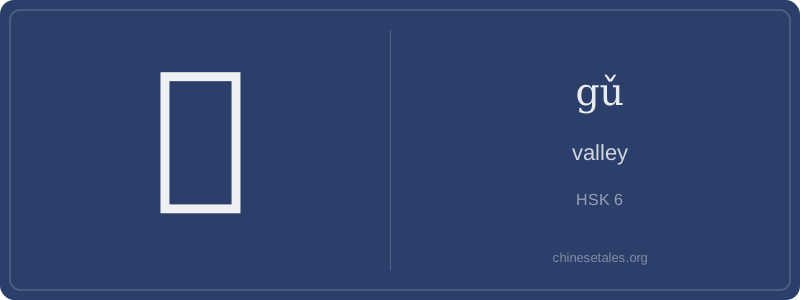
The earliest form of 谷 appears in oracle bone script (c. 1200 BCE) as a vivid pictograph: two parallel mountain peaks (山-like shapes) enclosing a wavy line — representing a winding river or path snaking through the lowland. Bronze inscriptions simplified the peaks into angular 'V' shapes, and by the small seal script era, the central element evolved into 口 (kǒu, 'mouth'), not because valleys speak, but because 口 here stylized the fertile basin — a container for life. The modern 谷 retains those twin 'hills' (the left and right components resembling inverted '八') cradling the 'mouth', now written as 八 + 口 — seven strokes total, each echoing topography.
This visual logic shaped its meaning across millennia. In the Classic of Poetry, 谷 describes idyllic, protected realms ('in the deep valley, deer graze'). By the Warring States period, philosophers like Laozi elevated it metaphorically: 'The valley spirit never dies — it’s called the mysterious female' (Tao Te Ching Ch. 6), linking physical lowland to spiritual openness. Even today, when Chinese say '虚怀若谷', they’re invoking that ancient image — not just 'humble', but *geologically humble*: wide, deep, and quietly full.
At its heart, 谷 (gǔ) is the quiet, sheltered space between mountains — not just a geographical feature, but a Chinese cultural archetype for humility, receptivity, and hidden abundance. Unlike English 'valley', which often implies emptiness or low status, 谷 carries positive resonance: in Daoist thought, it’s the 'valley spirit' (谷神) — soft, yielding, yet endlessly generative. Think of it as nature’s open palm, cradling rivers, rice paddies, and villages.
Grammatically, 谷 behaves like a concrete noun but punches above its weight. It appears in compound nouns (山谷, 深谷), classical allusions (e.g., '虚怀若谷' — 'humble as an empty valley'), and even modern tech terms like '硅谷' (Silicon Valley). Learners often misread it as 'grain' due to its homophone 谷 (gǔ) — yes, the same character means 'grain' too! But that’s not a mistake — it’s a brilliant semantic bridge: ancient valleys were grain-rich basins, so the shape *is* the meaning, and the meaning *is* the sustenance.
Culturally, 谷 shows up where depth matters: in poetry (Du Fu’s 'the valley echoes with autumn wind'), martial arts ('valley breath' techniques), and even internet slang ('谷子' for collectible merch — a playful extension of 'harvesting' fandom). A common error? Confusing it with 味 (wèi, 'taste') or 容 (róng, 'to contain') — but remember: 谷 has no mouth radical, no roof — just two hills framing fertile ground. Its silence is its strength.